When you think of the word "metals," you are as likely to think about everyday objects and their function as you are chemistry or anything else related to science. Most machines and many structures, for example, are made of one of more metals because of the durability and rigidity these materials offer. In addition, some metals are valued for their appearance, cost a great deal of money per unit mass and are literally classified as "precious metals"; gold and silver are perhaps the most well-known examples.
But metals also represent one of the three types of elements in chemistry, the other two being nonmetals and metalloids. Metals actually account for the majority of elements in nature, although you are likely to have heard of only a small fraction of these. Before exploring the properties of metals, it's helpful to understand just what is known by the term "element" and how the periodic table is used to structure elements on the table.
What Are Elements?
In everyday life, an "element" is a component of a whole. The word has a similar, but more strict, definition in chemistry: An element is something made from one particular type of atom. It cannot be further divided into simpler components using everyday chemical tools. As of 2018, chemists had identified 92 naturally occurring elements, along with 11 unstable elements that have been generated under laboratory conditions. A given element exists as either a solid, a liquid or a gas in its native form.
An atom in turn is a microscopic collection of protons, neutrons and electrons in some combination. Hydrogen, the simplest atom, consists of only a proton and an electron; uranium, the most massive, has 92 protons, 92 electrons and 146 neutrons in one of its isotopes. An atom usually has the same number of protons, which carry a positive charge, and electrons, which carry a negative charge of equal magnitude. The number of neutrons, which along with protons make up the nuclei (singular nucleus) of atoms and have no electrical charge, approximates the number of protons to some extent, although as elements ascend in size, neutrons tend to outnumber protons to a greater and greater extent.
The Periodic Table of Elements
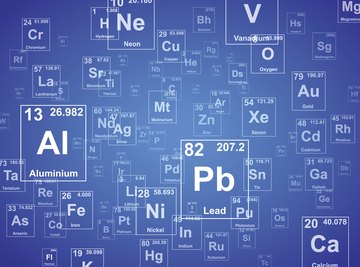
The periodic table is to chemistry what an indexed list of ingredients is to a cookbook. Any chemical compound you have or can think of, large or small, can be reduced to some combination of the elements on the periodic table.
The 113 elements are arranged on this table in ascending order by atomic number. This number is just the number of protons an element has. If this number changes, the element's identity changes. This is not true of neutrons or electrons; variations of an element that contain different numbers of neutrons are called isotopes of that element, whereas an element that has more or fewer electrons than it has protons is called an ion and carries a positive or negative electrical charge.
The periodic table gets its name because it includes categories of elements that repeat themselves periodically and predictably. When you look at a periodic table (see Resources for an interactive example), you can see that it has some curious gaps in the rows at the top but that these disappear with the higher-numbered elements. This is because the elements have not merely been arrayed based on atomic number; they have been slotted into types based on their various atomic and chemical properties.
Periodic Table Groups
Strictly speaking, elements can be grouped into metals and nonmetals, but traditionally there are three element groups: metals, nonmetals and metalloids. As the name "metalloids" suggests, these elements have both metal-like and non-metal-like properties.
There are also three basic types of metals: alkali metals, alkaline earth metals and transitional metals. The transitional metals include a number of subcategories of their own, described later.
The elements classified strictly as nonmetals are surprisingly few in number, with only seven of them (H, C, N, O, P, S and Se) dotting the periodic table. This classification, however, excludes nonmetals that have earned their own categories, including the five halogens (F, Cl, Br, I and At ) and the six noble gases (He, Ne, Ar, Kr, Xe and Ra).
Characteristics of Metals
As there are seven metalloids and 18 nonmetals of some sort (seven nonmetals per se, six noble gases and five halogens), 88 of the 113 elements on the periodic table are classified as some type of metal. While these clearly range considerably in their properties, metals share a number of characteristics in common.
Metals are solid at room temperature with the notable exception of mercury, a liquid used in older thermometers. They have luster, meaning that they reflect light, a property that often affords them value (e.g., copper, silver). They are malleable, meaning that they can be physically shaped into thin sheets without fracturing. They are typically hard, although potassium and sodium, which serve as biologically active ions in the human bloodstream, can be cut with an ordinary knife. They are ductile, which is a fancy way of saying that metals can be made into wires; this property convenient because most metals are good conductors of electricity and heat, making them crucial to modern industrial applications. Their conductivity is a consequence of having electrons that are not tightly bound to the nuclei. Finally, metals are usually dense (that is they have a high mass per unit volume), and they have high boiling and melting points. Tungsten has an extraordinarily high melting point, and it's no accident that this element is widely used in light bulb filaments.
Types of Metals
The three categories of metals are the alkali metals, the alkaline earth metals and the transition metals. The arrangement of the periodic table comes in handy for keeping these closely grouped; the alkali metals are the six elements directly underneath hydrogen (H) in the far-left column of the table, which is labeled IA. The alkaline earth metals are the six "next-door neighbors" of the alkali metals on the table, occupying all of column IIA.
The transitional metals occupy columns III through XII and rows 3 through 6 on the periodic table, for a total of 40 elements. The 14 lanthanides (elements 58 through 71) and the 14 actinides (elements 90 through 103) are considered rare-earth metals. Finally, in most schemes, eight elements are considered metals not otherwise specified, bringing the total number of metals to 6 (alkali) + 6 (alkaline earth) + 40 (transitional) +28 (rare earth) + 8 (unspecified) = 88.
Metalloids and Nonmetals
These seven elements with both metal-like properties and non-metal-like properties occupy portions of rows 3 through 6 in the periodic table, and include:
- B
- Si
- Ge
- As
- Sb
- Te
- Po
These are solid at room temperature and useful in the realm of semiconductor technology, and often form alloys, or combination metals, with other metallic elements.
References
About the Author
Kevin Beck holds a bachelor's degree in physics with minors in math and chemistry from the University of Vermont. Formerly with ScienceBlogs.com and the editor of "Run Strong," he has written for Runner's World, Men's Fitness, Competitor, and a variety of other publications. More about Kevin and links to his professional work can be found at www.kemibe.com.