How to Relieve a Sore Mouth From the Side Effects of Amoxicillin
Amoxicillin is a form of penicillin, which is an antibiotic that treats numerous bacterial infections such as strep throat. Tell your doctor about all the other medications you are taking and any allergies so he can make sure amoxicillin is right for you. According to MayoClinic.com, a sore mouth is a mild and common side effect of the medication that does not require medical treatment and usually goes away on its own after a period of time.
If you are experiencing serious medical symptoms, seek emergency treatment immediately.
Avoid foods and beverages that are hot. Also avoid spicy and salty foods and acidic citrus fruit.
How to Get Rid of Tongue Sores
Learn More
Eat popsicles and gargle with cold water to help ease mouth pain.
Take over-the-counter pain relievers like acetaminophen and ibuprofen.
How to Get Rid of Oral Thrush With Natural Herbs
Learn More
Rinse with salt water if you have a canker sore. You can also combine equal parts hydrogen peroxide and water, apply the mixture directly to the sore with a cotton swab, then lightly dab Milk of Magnesia on the sore three to four times daily. This mixture is soothing and might help the canker sore to heal, notes PubMed Health 4.
Tips
A canker sore is an open sore in the mouth that is usually quite painful. The sores are white or yellow and encircled in a bright red area. Canker sores are not contagious.
Mouth sores heal on their own in about 10 to 14 days, indicates MedlinePlus.
Warnings
If your sore mouth is very severe, is accompanied by other symptoms like fever and swollen glands and does not resolve after a few days, see your doctor.
Related Articles
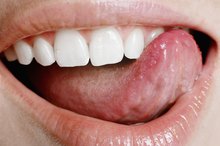
How to Get Rid of Tongue Sores
Learn More

How to Get Rid of Oral Thrush With Natural Herbs
Learn More

A Sore Throat & Swollen Tonsils
Learn More

How to Get Rid of a Cold Sore on the Tongue
Learn More

How to Get Rid of Sticky Mucus in My Mouth
Learn More

How to Heal Tongue Sores
Learn More

What Are the Causes of an Infection of the Tonsils?
Learn More

A Canker Sore in a Toddler
Learn More

How to Safely Gargle Hydrogen Peroxide
Learn More

How to Get Rid of Swollen Taste Buds
Learn More
References
- Drugs.com; Amoxicillin; August 2010
- MayoClinic.com; Penicillin; May 2011
- MedlinePlus; Mouth Sores; November 2010
- MacDonald J. Canker sore remedies: baking soda. CMAJ. 2002;166(7):884.
- Rashed HT. Evaluation of the effect of hydrogen peroxide as a mouthwash in comparison with chlorhexidine in chronic periodontitis patients: A clinical study. J Int Soc Prev Community Dent. 2016;6(3):206–212. doi:10.4103/2231-0762.183114
- Rubenstein EB, Peterson DE, Schubert M, et al. Clinical practice guidelines for the prevention and treatment of cancer therapy-induced oral and gastrointestinal mucositis. Cancer. 2004;100(9 Suppl):2026-46. doi:10.1002/cncr.20163
- Subiksha PS. Various Remedies for Recurrent Aphthous Ulcer-A Review. J Pharm Sci & Res. 2014;6(6):251-253.
- Altenburg A, El-Haj N, Micheli C, Puttkammer M, Abdel-Naser MB, Zouboulis CC. The treatment of chronic recurrent oral aphthous ulcers. Dtsch Arztebl Int. 2014;111(40):665–673. doi:10.3238/arztebl.2014.0665
- The American Academy of Oral Medicine. Canker Sores - Treatment. Updated December 31 2007.
- Belenguer-Guallar I, Jiménez-Soriano Y, Claramunt-Lozano A. Treatment of recurrent aphthous stomatitis. A literature review. J Clin Exp Dent. 2014;6(2):e168–e174. doi:10.4317/jced.51401
- Canker Sore. MedlinePlus.
- Edgar NR, Saleh D, Miller RA. Recurrent Aphthous Stomatitis: A Review. The Journal of Clinical and Aesthetic Dermatology. 2017;10(3):26-36.
- Parmet S, Lynm C, Glass RM. JAMA patient page. Sore throat. JAMA. 2004;291(13):1664. doi:10.1001/jama.291.13.1664
- Stead W, Aronson M, Bond S. Patient education: Sore throat in adults (Beyond the Basics). Jun 3, 2019.
- Renner B, Mueller CA, Shephard A. Environmental and non-infectious factors in the aetiology of pharyngitis (sore throat). Inflamm Res. 2012;61(10):1041-52. doi:10.1007/s00011-012-0540-9
- Sore Throats. American Academy of Otolaryngology-Head and Neck Surgery.
- Pelucchi C, Grigoryan L, Galeone C, et al. Guideline for the Management of Acute Sore Throat. Clinical Microbiology and Infection. 2012;18:1-27. doi:10.1111/j.1469-0691.2012.03766.x.
- Stead W. Patient Education: Sore Throat in Adults (Beyond the Basics).
Writer Bio
Jackie Carmichael has been a freelance writer for more than 10 years. Her work has appeared in "Woman's World" and "American Baby" magazines. Carmichael is a licensed registered nurse and has worked in fields related to cardiovascular health and psychiatry. She also holds a Bachelor of Arts in journalism from The Ohio State University.