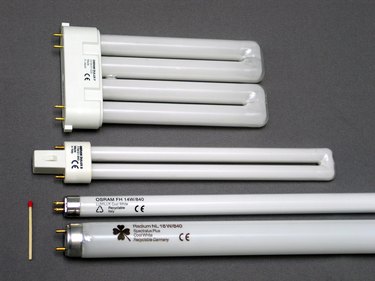
At one time, if you had fluorescent lights in your home, it required specialized light fixtures to hold long metal fluorescent tubes (lamps) connected at the ends of the fixtures with metal pins. The fixtures themselves included an internal ballast to regulate the electrical current flowing to the lamps. Today, fluoresent fixtures come in many shapes and sizes, with specialized fluorescent lamps available to match them.
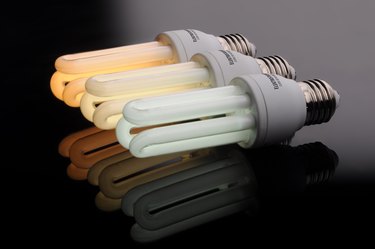
Also available now are screw-in compact fluorescent light (CFL) bulbs that will fit standard light fixtures. Strictly speaking, these are not "bulbs," but instead are highly specialized tubes in which the screw base contains a miniaturized ballast that regulates the current flow, just as they do in a standard fluorescent light fixture.
Video of the Day
Video of the Day
Whatever the style of light fixture and bulb, though, fluorescent lighting is much more efficient than standard incandescent light bulbs.
What Is a Fluorescent Light?
In a fluorescent light fixture, a gas mixture consisting of mercury vapor and other gases inside the lamp becomes energized when electrical current excites it, producing a short-wave ultraviolet light that then causes a phosphor coating on the inside of the lamp/tube to glow. It is the glowing phosphor that produces the illuminations. Fluorescent light fixtures typically put out 50 to 100 lumens per watt of power applied to the lamps — an amount that is several times higher than that of incandescent bulbs.
Fluorescent lights are often criticized for the quality of the light they emit — many people find it to be unnatural and "bluish" in color. However, adjustments to the phosphor coatings on the inside of the glass has allowed for the development of "soft white" fluorescent bulbs that emit light with a color that is much closer to that produced by standard incandescent light bulbs.
Despite the fact the fluorescent lamps of all kinds are much more energy efficient than incandescent bulbs, they have an important environmental drawback, in that all fluorescent bulbs contain a small amount of mercury that is very difficult to dispose of safely. Some manufacturers, in fact, are discontinuing production of fluorescent lamps in favor of LED (light-emitting diode) lamps, which pose fewer environmental hazards.
Standard Fluorescent Tubes
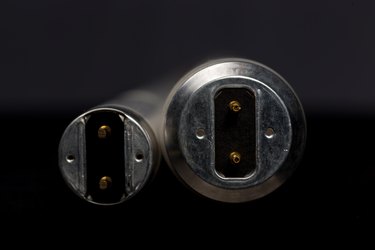
Standard fluorescent tubes come in two primary types: T8 and T12. Each type has its own set of advantages and disadvantages.
Size
One primary difference between T8 and T12 fluorescent tubes is the size of the tubes and their bases. While both bulbs come in standard lengths, commonly 4 feet, the designation of 8 or 12 refers to the difference in the diameter of the bulb. T8 bulbs are 8/8 inch (a full inch, in other words), while T12 bulbs are 12/8 of an inch in diameter — 1 1/2 inches.
Energy Usage
Another area in which these tubes differ is in their energy usage. A T8 tube is 32 watts, while a T12 tube is 40 watts. This makes the T8 a more energy-efficient tube to use. A government standard known as the Federal Minimum Energy Standard requires buildings to start using energy-efficient lighting, favoring the T8 over the T12.
Light Output
Both T8 and T12 tubes have similar light output; although the T8 puts out slightly more light, the difference is not noticeable to the human eye. According to Philips, a large manufacturer of lighting equipment, a T8 bulb produces around 2,600 lumens, while the T12 bulb puts out around 2,520 lumens.
Over time, the bulbs begin to lose their intensity and brightness. T8 tubes have a slower period of decrease, losing only 10 percent of their initial brightness after 7,000 hours of use. In comparison, T12 tubes can lose 20 percent, or double the T8 loss, after the same number of hours.
Other Considerations
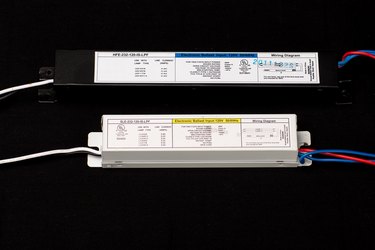
A ballast is the component that limits the electrical current flowing to a fluorescent tube, and there are two styles by which they may operate. Older magnetic ballasts (also called inductor ballasts) are quite dependable, but they are heavy and often emit a hum or buzz that many people find annoying. Electronic ballasts control current flow with solid-state circuitry, and are lighter in weight and usually quieter. Electronic ballasts also require less energy. They are often used with T8 tubes for maximum energy savings.
Lifespan of Standard Tubes
While both types of bulbs do begin to lose some of their brightness after 7,000 hours of use, most people tend not to replace the bulbs until they begin to flicker or burn out completely.
Manufacturer recommendations suggest that users replace the bulbs every six to 12 months due to a slow decrease in brightness, but the difference is not usually noticeable to the naked eye. Bulbs running 10 hours a day daily can last up to two years before showing noticeable signs that they're in need of replacement.
Compact Fluorescent Lamps (CFL)
The newer generation of fluorescent lighting is represented by compact fluorescent lamps (CFLs) that feature a metal threaded base that can screw into the socket on any standard light fixture. Aside from the fact that they fit standard light fixtures, CFLs have all the advantages and drawbacks of standard fluorescent tubes.
Compared to incandescent lamps, CFLs use one-fifth to one-third the electric power, and last eight to 15 times longer. While a CFL bulb has a higher purchase price than an incandescent, it can save more than five times its purchase price when energy savings are measured. Like all fluorescent lamps, CFLs contain toxic mercury that makes safe disposal difficult. In most communities, these lamps cannot be disposed of with normal household trash and must be taken to special processing centers or set aside as hazardous waste.
Like older fluorescent tubes, early CFLs used a magnetic ballast built into the socket base, which sometimes caused the light to flicker in an annoying manner. Newer bulbs use an electronic ballast mechanism to eliminate the flickering, and this, combined with refinements in the phosphor coatings inside the bulbs make CFLs a very good replacement for incandescent light bulbs.
Dimmable vs. Non-dimmable
Not all CFL light bulbs can be used with dimmer switches, and doing so can actually pose a fire hazard. Standard dimmer switches operate by producing oscillating current to the light fixture, and this fluctuation in current can cause the CFL to consume more current than it is meant to, which may cause the bulb to overheat to dangerous levels.
Look for CFL bulbs that are designated for use with dimmer switches. This labeling is usually printed right on the base of the bulb.
Outdoor Use
CFLs are generally not intended for outdoor use, since at low temperatures they will not operate correctly, and sometimes may not operate at all. However, there are CFLs constructed with special cold-weather ballasts that will work at temperatures down to minus 20 degrees Fahrenheit.
CFLs Are Becoming Obsolete
As LED light bulbs fall in price to $5 or less, they have begun to replace CFLs as the best choice for household use. With lifespans and energy usage that are considerably better than CFLs, the newer LED light bulbs are rapidly becoming the best choice for consumers, especially since they contain fewer environmental hazards than CFLs.
Disposal of Fluorescent Tubes and Bulbs
No matter what the type, all fluorescent tubes and bulbs contain some amount of toxic mercury in the gases inside them. Virtually all communities mandate special handling of old lamps, and consumers who throw them away in household trash may be guilty not only of breaking the law but of violating common-sense decency. The health risks of mercury are now well established, and include neurologic disorders (especially for children), and kidney and liver damage. In addition, the ballasts in fluorescent light fixtures may contain toxic substances, as well. Older fixtures, those manufactured before 1980, almost certain contain PCBs, a known cancer-causing agent. Always follow proper recycling practices when disposing of fluorescent tubes, bulbs or fixtures.