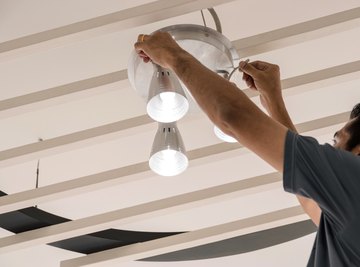
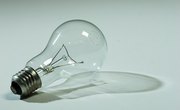
Both incandescent and halogen bulbs are widely chosen by consumers to serve their lighting needs. Incandescents are inefficient for the amount of power they draw but that has yet to affect their popularity. Both types of bulbs have many uses and, of course, possess advantages and disadvantages.
-
-
Halogen bulbs are a more efficient version of the incandescent bulb. These bulbs emit very bright white light. Their light output will not diminish as the bulb ages. Halogen bulbs are also known for their consistent ability to start up with no flickering.
-
The idea of the incandescent light bulb is nearly 120 years old and little has been needed in the way of innovation to increase popularity. An incandescent light bulb glows when electricity heats wire filaments. However, these light bulbs give off more heat than light in terms of energy output. This is why the classic incandescent light bulb is considered inefficient for the amount of electricity it drains.
-
Incandescent light bulbs fade with age, unlike halogen bulbs. An average incandescent bulb will last anywhere between 750 and 1,000 hours. An average halogen bulb will last anywhere between 2,250 and 3,500 hours. A 75 watt incandescent bulb produces around 1,180 lumens of light while a 75 watt halogen bulb lets off about 1,300 lumens. Both incandescent and halogen light bulbs are available in a variety of sizes and voltages.
-
Standard incandescent light bulbs are great for everyday use in the home where "soft" light is desired. Some incandescent light bulbs are used not only for their light output but for their heat output as well. Heat lamps found in reptile tanks utilize the heat producing capabilities of incandescent bulbs to warm small, contained environments.
Halogen bulbs keep a constant light output throughout their lives which is one of the reasons why they are widely used in car headlights. This type of bulb is ideal for outdoor situations like lighting up a deck or patio. Halogen lights can also be used in the home where intense light is desired.
-
Incandescent bulbs are generally much cheaper than halogen bulbs. Obviously, the higher the wattage, the more a light bulb of any type will cost. A 75 watt incandescent bulb will generally cost less than 65 cents per bulb. A 75 watt halogen bulb can average about $4 per bulb.
Read Next:
-
Halogen vs. Incandescent Power Consumption
While halogen light bulbs require less power to operate than incandescent light bulbs, neither are considered energy-efficient. They both require quite a...
-
Difference Between a Full Spectrum Halogen & an Incandescent Light
Full spectrum halogen light bulbs burn brighter, whiter and hotter and last considerably longer than common incandescent light bulbs. "Full spectrum" lighting...
-
Recessed Lighting: Halogen Vs. Incandescent
Recessed lighting can add a modern, sleek look to any home space. It provides excellent luminosity without adding ceiling clutter or pesky...
-
A Comparison of Halogen and Incandescent
One of the most overlooked choices by homeowners is the type of lighting to choose. Although the routine choice is the standard...
-
Halogen Vs. LED Light
Light-emitting diodes (LED) represent an energy-efficient alternative to traditional incandescent lighting without the disposal concerns of compact fluorescent ...
-
Should I Use Halogen or Incandescent Lighting Outside?
Should I Use Halogen or Incandescent Lighting Outside?. Halogen lights shed a much whiter, brighter light than incandescent lights. They are usually...
-
Compact Fluorescent Light Bulbs Vs. Halogen
Comments. You May Also Like. Fluorescent Vs. Halogen Light Bulbs. Fluorescent and halogen bulbs are more energy efficient than the classic incandescent...
-
Comparison of LED & Halogen
Gone are the days when the only lighting option was a simple, white bulb. Nowadays, light bulbs come in many shapes and...
-
How to Convert an Incandescent Flood to a Halogen
Halogen bulbs are 10 to 20 percent more efficient than ordinary incandescent bulbs. This efficiency is accomplished through a tungsten filament, which...
-
Xenon Vs. Incandescent Lights
There are several differences between xenon light bulbs and incandescent light bulbs. Each type of light bulb has several practical applications. Perhaps...
-
Incandescent vs. Fluorescent Wattage
In terms of energy consumption, fluorescent light bulbs are much more efficient than incandescent light bulbs. Compared with incandescent light bulbs, fluorescent...
-
Fluorescent Vs. Halogen Light Bulbs
Fluorescent and halogen bulbs are more energy efficient than the classic incandescent bulb. They tend to provide better lighting as well as...
-
Halogen Light Bulb Dangers
Though halogen light bulbs are used in many ways, the main culprit of the fires is the halogen torchiere lamp, an in-home...
-
LED Versus Halogen Lighting
There are several advantages associated with both LED (light-emitting diode) and halogen light bulbs. In terms of efficiency, LED lights are undoubtedly...
-
Efficiency of Low Voltage Halogen Vs. Fluorescent Light Bulbs
As traditional incandescent light bulbs are being replaced by more advanced bulbs, consumers are considering the efficiency of each available type. While...
-
Xenon Vs. Halogen Lighting
Xenon lights and halogen lights have countless practical applications. Each type of light bulb has advantages and disadvantages. Despite the many benefits...
-
How Do 12V Incandescent Lamps Work?
Twelve-volt incandescent lamps use the same principles as standard incandescent bulbs--the kind you buy for your home--but they're designed to run on...
-
Compare Halogen Vs. Xenon Lights
Both halogen and xenon lights have their advantages and disadvantages. Halogen light bulbs are simple incandescent light bulbs with a slight modification:...