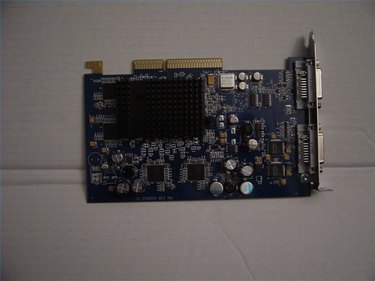
If your computer is having a hard time playing the newest video games or smoothly playing HD video content, it may be time to upgrade your video card. Many computers include on-board, or built-in, graphics cards. Adding a separate video card will improve the playback of video games and video, but it is important to know which type of graphics card is correct for your computer.
On-Board
Video of the Day
Most budget-based PCs will include on-board graphics in lieu of separate graphics cards occupying an expansion slot. On-board video is usually not powerful enough to play graphics-intensive games or decode high-quality video. If on-board graphics are to be replaced with an add-on graphics card, the on-board graphics will have to be disabled in the computer's BIOS, because you cannot physically remove them.
Video of the Day
PCI Express
As of 2009, the standard in video cards is the PCI Express. NVIDIA and ATI, the two largest graphics card manufactures, are only producing PCI Express graphics cards. PCI Express has three architectures, with the newest being PCI Express 3.0. Some PCI Express graphics cards have the ability to share the graphics processing with another graphics card. The computer motherboard and graphics card will have to support SLI for NVIDIA cards or CrossFire for ATI cards.
AGP
Accelerated graphics port, or AGP, was the standard graphics card type in the early to mid-2000s. AGP cards are not widely available today, because they have been replaced by PCI Express, and most hardware manufacturers are not including AGP ports in their systems. NVIDIA released its final AGP graphics card with its GeForce 7 series. ATI released a Radeon HD 4000 series AGP card in 2008; however, the company has not released a new one since.
External Graphics Cards
Since laptop computers do not have any available space for an add-on graphics card, some manufacturers have produced external graphics cards to give a boost to laptop graphics. Some of these cards are based on the ExpressSlot, while others are used in-line to an external monitor.
Legacy Graphics Cards
There are a number of other graphics cards that are not widely used today, such as standard PCI, VESA local bus and ISA graphics cards. The aforementioned cards would not be able to support current versions of Windows, let alone video or graphical games.