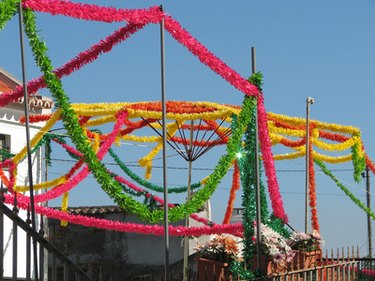
"Fiesta" is the Spanish word for festival or holiday. Mexico has several different kinds of festivals, typically celebrated for religious, national and local reasons. The type of celebration varies with the kind of Mexican festival. Generally, there is a party at the end of the celebration, and it is accompanied by traditional Mexican music, usually rendered by a lively local Mariachi band.
Location and History -- Mexican Lore
Video of the Day
Mexico was originally inhabited by native Americans, and their descendants constitute a large part of the country's population today. Mexico was a Spanish colony from the early 16th century to independence in 1821. During the 10-year independence war, and subsequent uprisings and revolutions, a popular democracy was established. Mexico celebrates a number of national holidays commemorating events from the liberation from Spain and subsequent national foundation events.
Video of the Day
National Mexican Statutory Holidays
The national holidays are either statutory holidays, when workers are given automatic leave, or civic holidays. The statutory holidays mostly celebrate events relating to the founding of the nation, such as the promulgation of the new constitutions in 1857 and 1917. Independence Day on Sept. 16 and Revolution Day on Nov. 20 are also statutory holidays, as is Dec. 25, which is both a secular and religious holiday in Mexico.
Mexican Civic Holidays
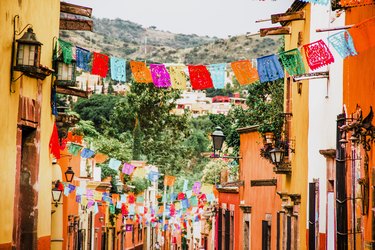
The civic holidays are related to civic events, such as the Army Day, Flag Day, Anniversary of Oil Exploration and Heroic Defense of Veracruz day, which celebrates the victory over the United States. Cinco de Mayo (May 5), which celebrates the victory against the French occupation forces in 1862, is not a major holiday. Many cities and Mexican states also celebrate their own civic holidays with Mexican festivals.
Religious Festivals in Mexico
The Mexican religious calendar celebrates a number of Catholic religious holidays. Most cities have their own patron saint, who is celebrated with his or her own festival. In particular, Epiphany, Day of the Dead (All Saints Day), Christmas and Holy Week (Easter) are celebrated. The Mexican patron saint, the Virgin of Guadalupe, is celebrated on Dec. 12. Many religious celebrations are colored by the local folk traditions handed down from the native Americans.
Celebrating Mexican Fiestas
Festivals in Mexico, both religious, national and local are celebrated with parades, dancing and music. Civic Mexican festivals are often celebrated with fireworks, in particular those related to events like the foundation of the city or the promulgation of the constitution. The religious holidays are also celebrated by street processions, called posadas, which intend to commemorate the journey of Mary and Joseph to Bethlehem. Carnival is celebrated in February and March, with processions, masquerades and street parties. Religious as well as civic holidays are celebrated with a festive family dinner.
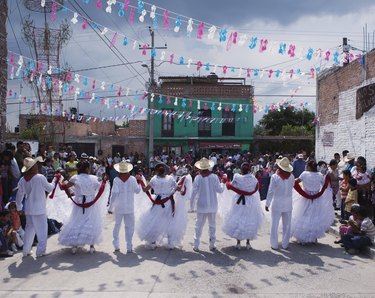
Music and dancing are integral parts of the celebrations, many of which also feature a traditional pinata. This colorful container made from a base of clay or paper contains goodies such as fruits, candies and small toys is particularly popular at parties given for youngsters. The game requires that those in attendance be blindfolded and take turns trying to break open the pinata with a large stick, thereby scattering the treats for all to enjoy.