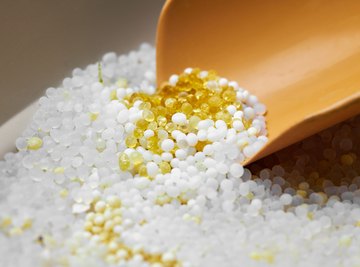
Sodium silicate, commonly known as “waterglass”, is prominent due to wide commercial and industrial application. It is often composed of an oxygen-silicon polymer backbone housing water in molecular matrix pores. Sodium silicate products are manufactured as solids or thick liquids, depending on intended use. For instance, waterglass functions as a sealant in metal components. Lastly, although sodium silicate production is a mature industry, there is ongoing research for new applications given its heat conductive properties.
Molecular composition
Sodium silicate is a silicon-oxygen polymer containing ionic sodium (Na+) components. Such a molecular arrangement is different from typical ionic materials such as salt, which is based on formula units united by electrical attraction. By contrast, sodium silicate is similar to carbon-based plastics since silicon-oxygen-silicon bonds between each monomer are covalent. The polymer-like nature of the sodium silicate matrix as well as the polar character of oxygen and sodium atoms allows for bonding of water molecules within the polymer matrix. Therefore, sodium silicate products often exist in hydrous allotropes. (Wells, "Structural Inorganic Chemistry").
Synthesis
A synthesis scheme for the substance involves a combination of sodium carbonate (Na2CO3) and silicon dioxide (SiO2) under conditions sufficient to melt both reactants. Sodium silicate is produced by this method with sufficient efficiency to be of commercial use. (Greenwood, "Chemistry of the Elements")
Physical properties
Physical properties of sodium silicate-based substances make them very attractive for commercial/industrial use. Liquids and solids based on sodium silicate and produced by PQ Corporation have a density from 1.6g/cubic cm. to about 1.4 g/cubic cm. Also note that the data tables contain information on the observed state of each product under moderate conditions. Sodium silicate products exist as white solid and a variety of liquids with visibly different properties. Differences in reaction conditions and manufacturing methods lead to clear, opaque, and “syrupy” waterglass products. (PQ, "Sodium Silicates. Products and Specifications")
Use
Use varies depending on manufacturing method, product grade, and setting agent. For example, the Schundler Company lists various uses for sodium silicate products in "Application of Perlite/Silicate Composites". Due to sodium silicate molecular structure incorporating hydrates, the waterglass functions as a sealant activated by sufficient heating. If a crack in metallic machinery needs to be sealed, poured sodium silicate “liquid glass” seeps into every crevice of the fracture. Upon heating to about 200 degrees Fahrenheit, water molecules in the sodium silicate matrix evaporate, leaving a hard, brittle sealant. (Schundler, "Silicate Composites for High-Temperature Insulation")
Research
Sodium silicate products are being researched for heat dissipation use. As the cited publication states, electronic devices are limited by, among other things, heat generated by electric current. Unless an electronic conductor is perfect (a superconductor), heat is generated. Though very small individually, the cumulative effect of dense electronic circuits is enough to threaten component physical integrity. In order to dissipate heat more efficiently to the environment, sodium silicate is being studied. Various thermal interfaces, dissipater thickness, and dissipater pressure are being researched to facilitate further electronic miniaturization. (SUNY, “Sodium Silicate Thermal Interface”)
References
- Wells, A.F. Structural Inorganic Chemistry, (fifth edition). Copyright 1984.
- Norman Greenwood, Earnshaw. Chemistry of the Elements (second edition). Copyright 1997
- PQ Corporation. (PQ). "Sodium Silicate. Products and Specifications"
About the Author
I am applying to be an Expert focusing on sci/tech/economic topics. The above "blog" link was my overall blog. From it, I would like to highlight some choice entries reviewing Ian Stewart's "Flatterland", a response and "supplement" to Edwin Abbott's classic "Flatland -- A Romance Of Many Dimensions" 1. http://numbersandpatterns.wordpress.com/2009/07/09/flatterland-review-1/ 2. http://numbersandpatterns.wordpress.com/2009/07/18/flatterland-review-2/ 3. http://numbersandpatterns.wordpress.com/2009/07/24/flatterland-review-2-5-fractal-afterthought/ 4. http://numbersandpatterns.wordpress.com/2009/08/03/flatterland-review-3/