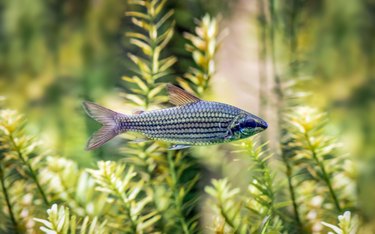
Tetra fish are a great choice for home aquariums for a variety of reasons. They are small, which means that a tank can hold many of these colorful fish. There are so many types of tetras that come in all colors of the rainbow, and they have a unique appearance, with a stripe on each side of their body that is nearly see-through. Setting up a tank and finding tankmates for tetras is easy, so they are satisfying for both beginner and experienced aquarium fans.
How big do tetras get?
Video of the Day
It's important to know which species of tetra you are talking about when you are deciding on species that will coexist well with your tetras. The smaller tetras, such as neon, lemon, ruby, serpae, black phantom, cardinal, and glowlight tetras, typically grow no larger than two inches and are a favorite in many community tanks. You would not want to put tetras with oscars and gouramis, which can grow quite large and will likely consider them prey.
Video of the Day
The majority of tetra species are in the midrange size and typically don't get longer than three inches. This group includes black skirt, bleeding heart, Buenos Aires, and Congo tetras. Large tetras, such as long-finned and bucktooth tetras can grow to four or five inches. In the mid-to-large range size, good tetra compatibility choices are smaller types of cichlids like African cichlids and angel fish.
Tankmates for tetras
The best tetra fish tankmates for small tetras are other small tetras. Because they are rarely aggressive with other species their own size, and because they like similar environments, tetra species co-exist well together. Choose types that provide a variety of colors and fin shapes for your tank. Neon tetras are some of the most popular types of tetras.
Neon tetra tank mates should be small, as they only grow to be about one to two inches long. Neon tetras have a bright red stripe on their sides, and they love to be in a school, so you can get up 15 to 20 if your tank is the right size, and enjoy their flashy color as they swim around in a large group. Platys, guppies and mollies make good tank mates for both small and midsize tetras.
They are colorful and easy to maintain, like tetras, and are generally nonaggressive toward other species. They like a planted tank with rocks, ceramics and other places to hide yet plenty of space to swim, and they eat much the same food as tetras. Larger tetras are usually peaceful and enjoy having other tetras around. They also do well with danios, corydoras, discus fish, most livebearers and some peaceful dwarf cichlids, such as apistogrammas. Like most other tetras, they are hardy and easy to maintain.
Scavengers and tetras
Bottom feeder scavengers and algae eaters are important members of a healthy aquarium. They clean the tank of waste and help keep down algae growth. Catfish species, corydoras and raspboras, a member of the carp family, provide this service for your tank. The plecostomus is another important bottom feeder. Although this one can grow quite large, he will not bother your other fish.
Overpopulation in a tetra tank
It's more fun to have a full tank as this gives you more movement to watch and color to enjoy in your tank. But having a tank that's too small for the number of fish you keep is one of the primary reasons that fish will become unhealthy. When each fish does not have enough space in a tank, they will often start to show aggressive behavior toward each other.
Even though there may be a lot of fish in a natural habitat, the amount of water per fish is much greater than a ratio that can be acquired in a home tank. This has the benefit of diluting the fish waste, even if there are a lot of fish in the lake or river, for instance. According to the Aquarium Guide, an overcrowded tank experiences low oxygen, which may mean that your fish won't swim around as much.
An overcrowded tank also has increased levels of ammonia and nitrite, which creates a toxic soup in the water. In high concentrations, nitrate can lead to bacterial and fungal infections. Overcrowding can lead to aggressive behaviors such as fin-nipping and stress.
A good rule of thumb is to provide a gallon of water per inch of fish, says Fish Tank World. For example, a 20-gallon tank could house approximately 20 inches of fish. This means you wouldn't want to put more than about eight neon tetras and three mollies together in a tank that size.