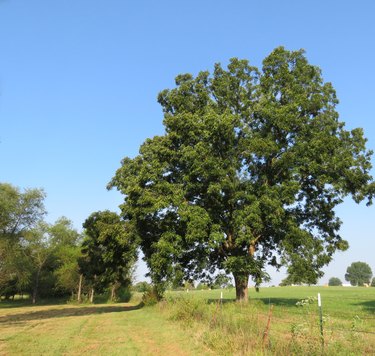
Everything about the pecan tree (Carya illinoinensis) is supersize, from its soaring height to its long lifespan to its enormous annual nut harvest. Pecan trees grow wild in the United States and also are cultivated widely for their fruit, the pecan nut, and wood with its beautiful grain. Facts about pecan trees may surprise and even astonish you.
Meet the Pecan Tree
Video of the Day
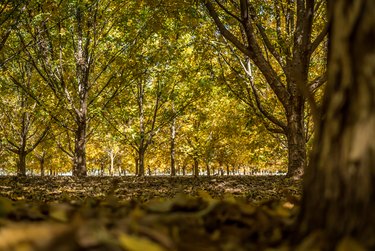
If you drive along the Mississippi River or cross the broad Midwest plains, you'll see the natural habitat of the pecan tree. But pecan trees thrive across a broad swath of the continental United States in U.S. Department of Agriculture plant hardiness zones 6 through 9. That includes California, Florida and Texas, which has selected the pecan tree as its official state tree.
Video of the Day
Pecan trees are cultivated for their prized wood that makes beautiful furniture. They are also the nation's most important commercial nut producer, and are gorgeous shade trees for those with large backyards. Don't even think of planting a pecan in a small garden. The tree's statistics should wake you up to the size of these giants. Pecan trees grow moderately fast and can shoot up to 100 feet tall and 75 feet wide when appropriately sited. Their trunks can grow to 7 feet in diameter.
Pecan trees are an investment for a lifetime, or maybe two or three. The trees can live more than 300 years, so the fact that you have to wait 10 years for the tree to bear nuts isn't all that bad.
Leaves, Blossoms and Fruit
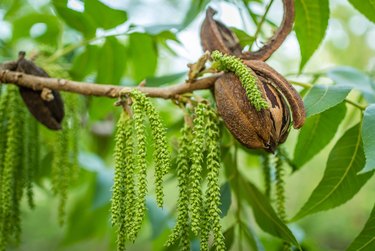
Pecan tree grow leaves, flowers and fruit. The leaves are compound, up to 20 inches long. Male flowers are catkins that dangle from the tree branches. Female flowers are star-shaped cups that face upward to catch pollen from the catkins.
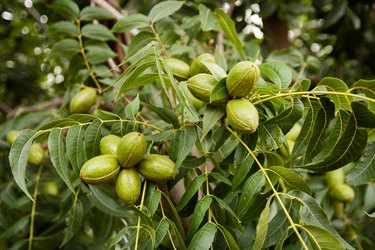
The fruit of the pecan tree is the pecan nut. The nuts have smooth brown outer skin that splits open when the nuts ripen. Pecan nuts grow in clusters of two to six. And once a pecan tree starts producing, you can expect an average of 75 to 150 pounds of nuts every single year.
Planting Pecan Trees
You have your pick of different types of pecan trees: native, seedling, grafted and pecan tree cross. Seedlings, native trees and pecan tree crosses are all grown from a pecan nut.
A native pecan tree typically grows from a nut that falls from a tree and begins to grow without any human intervention. Native pecan trees in stands are called pecan groves. Seedling pecan trees result when a female flower on a known tree is fertilized by pollen from an unknown tree to produce a nut that then germinates. Grafted pecan trees are those "created" by melding wood from a desirable pecan tree to a rootstock of another tree. The grafted pieces are chosen because of some desirable or beneficial characteristics that could aid their nut production and growth.
Once you determine which type to plant, pick a large site with at least six hours of direct, unfiltered sunlight each day. Pecan trees accept almost any type of soil, and will grow in well-drained, wet and clay soils.