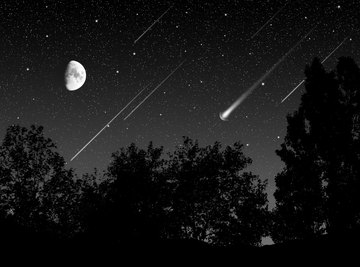
Among the most spectacular sights of the night sky are shooting stars. Unlike most celestial objects, shooting stars exist only briefly as they blaze across the sky and then suddenly fade. Shooting stars appear every night, as do several meteor showers in which dozens of shooting stars can appear every hour. For these reasons, many myths about shooting stars exist.
Misconceptions

The most common misconception about shooting stars is that they are related to stars. Shooting stars are actually meteors, bits of space dust from asteroids or comets that are burning up in the earth’s atmosphere.
Features
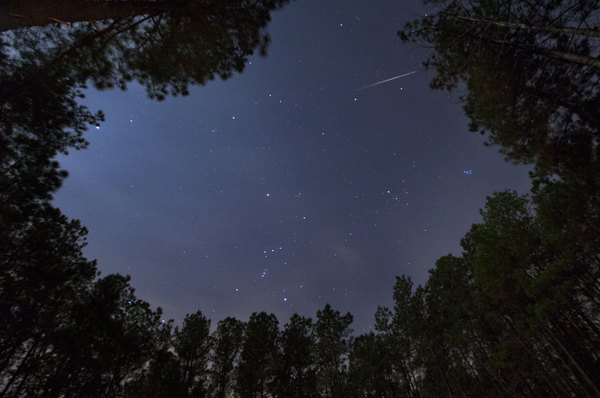
Because they are so sudden and short-lived, shooting stars inspire many myths about wishing and omens. Traditionally, shooting stars were seen as omens of dangerous times for Europeans. Current myths about shooting stars revolve around making a wish when one is seen.
Types

Although older myths about shooting stars generally held them as omens, modern myths are often more related to misunderstandings about science. Many people believe that meteors are large pieces of rock, maybe even big enough to kill a person or to destroy the earth. Actually, most meteors are no larger than specks of dust, and only the largest meteors even reach the ground.
Geography
Myths about shooting stars vary greatly around the world. In East Africa, some tribes consider them to be the manifestations of a deity, while others see them as bad omens. Native American tribes had a wide variety of beliefs about shooting stars, seeing them as war omens, as traveling spirits of shamans and heroes, and even as the feces of stars.
Considerations

Most shooting-star myths are based on beliefs related to the observed phenomena. Meteors do look like stars shooting through the sky. Their sudden appearance can be startling, which may explain why shooting stars are so often seen as bad omens. Occasionally, pieces of meteor do reach the ground, leading people to think that all shooting stars leave debris.
References
- Space: Meteor Showers and Shooting Stars: A Primer
- African Shooting Star Myths—Ethnology of A-Kamba and Other East African Tribes; C.W. Hobley; 1910
About the Author
Laurel Brown has several years experience as an educator and a writer. She won the 2008 Reingold Prize for writing in the history of science. Brown has a Ph.D. and Master of Arts in the history of science and Middle Eastern studies from Columbia University, as well as a Bachelor of Arts in astrophysics from Colgate University.
Photo Credits
Andrey Shalygin/Hemera/Getty Images