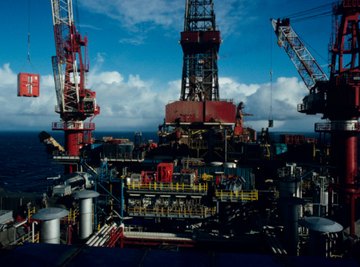
An oil drilling rig is a structure that houses equipment such as the derrick, pipe, drill bits and cables necessary to extract petroleum from beneath the earth’s surface. Oil drilling rigs can be either offshore for drilling into the ocean floor or land-based. Although both locations bring large amounts of oil to the petroleum market, the offshore drilling rigs have been more in the public eye since the 2010 oil spill off the coast of Louisiana in the Gulf of Mexico.
Jackups
According to Rigzone, the most often used offshore, movable drilling structures, called jackups, have bottom supports. The hull or main deck area is supported by columnar or open-truss legs. These units drill up to 350 feet deep.
Two types of drilling equipment are used on jackups. One, the most recent and the most used, is the cantilevered jackup, which has the drilling derrick mounted on an arm extending out from the main deck. These allow drilling to be done with or without platforms.
The other type, the slot-type or keyway jackup, has an opening in the drilling deck with a derrick positioned over it. This type of drilling unit can be jacked up over another smaller structure and drill down through its hull.
Floaters
Other offshore oil rigs, floaters, or semi-submersible drilling units float offshore on hollow columns or giant pontoons which when filled with water can submerge the rig to the required depth. This type of rig is normally used for drilling Wildcat Wells (new wells) and can withstand rough seas.
Fixed Platforms
More permanent offshore immobile steel or cement structures, called fixed platforms, house drilling rigs that open new development wells. These large units also house crew and equipment and are connected to the ocean floor. Most of these are found on continental shelves up to depths of 1,700 feet, and because of their directional drilling capacities can be attached to numerous wells up to a five-mile radius.
Complaint Towers
Another type of offshore drilling rig, the complaint tower, consists of a flexible, narrow tower supported by a piled foundation. Its conventional deck operates both drilling and production, and this sturdy unit sustains lateral forces and deflections in water from 1,500 to 3,000 feet depths.
Drillships
Drillships, usually built on tanker hulls, have been fitted with drilling devices and are used in deep water for experimental drilling. Dynamic positioning systems keep the ship over the well.
References
About the Author
Tonya Yirka is an Indiana-based writer who has focused on writing for online publications since 2009. She contributes many articles about Chinese culture and traditions to various websites. Yirka, a retired teacher, has a Bachelor of Science in education from Indiana University and attended classes toward a Master of Science in educational studies.
Photo Credits
Kim Steele/Photodisc/Getty Images