
A block and tackle is derived from the pulley. Pulleys are grooved wheels designed to be fitted with a cable or rope, and to turn freely within a block. The rotational effect of the wheel allows the user to change the direction of the force being used.
A man with a pulley can lift a load by pulling back or down on a rope, instead of lifting up. Using one or more pulleys in a network gains mechanical advantage, multiplying the force used to lift a load. When this is done, it is called a block and tackle.
Pulley Arrangement
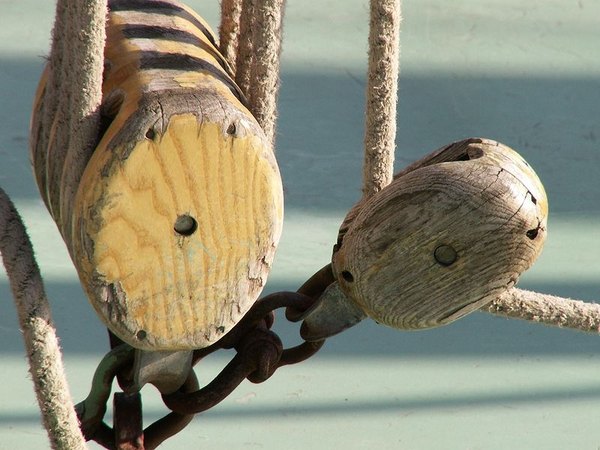
There are two types of pulleys in a block and tackle system, fixed and movable. The movable pulley is the one that has been hooked to the load itself and will move with it. The fixed pulley is hooked to a fixed point and does not move. The block and tackle pulley definition thus encompasses two physical arrangements.
What separates different types of blocks and tackles are how many wheels are in each pulley, and therefore how many turns of the rope are threaded through them (called "lines"). Each extra line in the system decreases the amount of force needed to move the load. For example, with two lines there is a mechanical advantage of 2 and a 400-pound load only requires 200 pounds of force to move.
Rigging
Blocks and tackles are also said to be rigged to either advantage or disadvantage. A block and tackle rigging holds an advantage when the rope is pulled in the same direction that the load will be moved. It is rigged to disadvantage when it is being pulled in the direction opposite of where the load is to be moved (pulling down on a load to be lifted, for example).
Rigging to disadvantage is less efficient in theory, but in actual practice it is sometimes necessary to arrange the pulleys and ropes this way because of issues like working space. Rigging to advantage usually increases the mechanical advantage by 1.
The Tackle
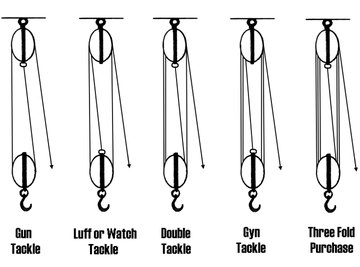
The gun tackle is the simplest form of block and tackle. It is made of one fixed and one movable pulley, each with one rope threaded through it. This two-pulley-one-rope arrangement has a mechanical advantage of 2.
Double luff tackles use pulleys with two grooved wheels. With four lines threaded through both pulleys, the mechanical advantage is 4 or 5, depending on whether it is rigged to advantage or disadvantage. This means such a tackle can move a 400-pound load with either 100 or 80 pounds of force.
The gyn tackle uses a three-wheel pulley in the fixed point, and a two-wheel pulley in the movable point. The mechanical advantage is either 5 or 6, depending on how the blocks are rigged. The 400-pound load can now be moved with either 80 or 67 pounds of force.
Effects of Friction
The practical limit that prevents the use of pulleys with dozens of wheels is the friction produced by the cable or rope grinding against the wheels in the pulley. With each new wheel, the friction increases, eventually multiplying into diminished returns.
Frictional force rises in proportion to the force applied to the pulley, so it cannot be overcome by simply pulling harder and exceeding a certain limit. Modern pulley systems can eliminate much of the friction of early models, yet cannot overcome this limitation entirely.