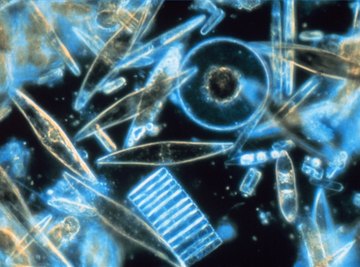

Phytoplankton are tiny photosynthetic organisms that are the major producers of marine life. They form the foundation of the food web for most marine life. They are responsible for half of the photosynthetic activity on earth, making them important to both their local and the global ecosystems. They are comprised of beings from different kingdoms. Their importance in carbon-dioxide sequestration has made them a target for controlling carbon dioxide in the atmosphere.
Facts
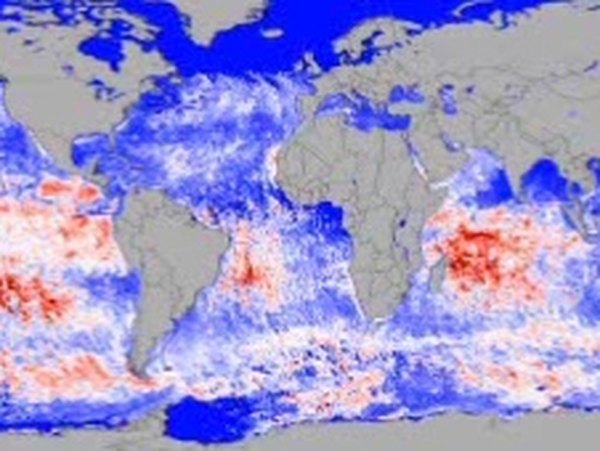
Phytoplankton are the photosynthetic portion of plankton life. Plankton are the tiny, drifting organisms that live in the top layers of ocean and lakes. Because phytoplankton rely on sunlight to produce their own food, they are found in the top layer of water. This layer, the epipelagic layer, goes down 200 meters. It is defined by the fact that enough light gets through the water to allow for photosynthesis.
Marine Ecosystems
Phytoplankton are vital to marine ecosystems. They are producers, or autotrophs, that form the foundation of most marine food webs. As photosynthetic organisms, they are able to convert solar energy into chemical energy and store it as sugars. Consumers, or heterotrophs, must consume energy that has already been converted into chemical energy. Consumers can either eat autotrophs directly, or eat other consumers. Phytoplankton are eaten by other small organisms, such as zooplankton.
Global Ecosystems
Phytoplankton are important to the global ecosystem as well as oceanic ecosystems. They are responsible for half of the photosynthetic activity on the planet. This means that of the carbon dioxide in the atmosphere that gets fixed into sugars, phytoplankton are doing half of the work. This makes them important to global carbon-dioxide levels. Without phytoplankton to pull carbon dioxide out of the atmosphere, carbon-dioxide levels would rise, because carbon dioxide would continue to be produced in both biological and industrial sources.
Types
Phytoplankton are in a group because of the ecological role, or niche, that they play. They consist of plants, animals, archaea and bacteria. Three of the major types of phytoplankton include diatoms, dinoflagellates and microflagellates. Diatoms are relatively large, reaching .2 mm in length, divide rapidly, and have minimal ability to control their movement. Dinoflagellates are smaller, divide less rapidly and have flagella to regulate their position in the water. Microflagellates are very small, divide slowly and, like dinoflagellates, have flagella for maneuvering.
Economic Importance
Phytoplankton's role in the global ecosystem has made them a target for controlling carbon-dioxide levels in the earth's atmosphere. Companies such as Climos and Planktos have invested in phytoplankton as a means of reducing carbon-dioxide emissions. They are investigating fertilizing phytoplankton communities with iron, a vital nutrient, to promote their growth. As political and economic pressures to provide carbon-dioxide emissions offsets increases, the potential profit of companies like these increases.
References
Resources
Photo Credits
Overview Image: Wikimedia Commons: Gordon T. Taylor (Public Domain), Section 1 Image: NASA sattelite image: nasa.gov (Public Domain)