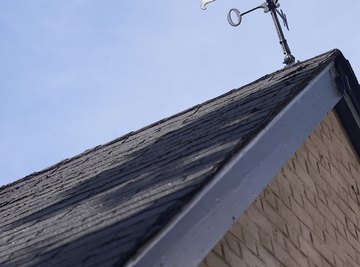

Prior to the introduction of modern technologies, early man had few ways to determine which way the wind blew. For centuries, wind vanes served as a simple means of detecting wind speed and direction, making them a critical tool for shipping, travel, agriculture and weather prediction. Today these wind vanes serve a largely decorative function, evoking a rich sense of history while still acting as a practical tool for those who need to track the wind.
Wind Vane Overview
The weather vane should be positioned at the highest point on a building and should be situated as far as possible from nearby structures that could interfere with its operation. These devices consist of a rotating horizontal arrow or other structure mounted on a stationary vertical rod. As the wind blows, the horizontal member rotates to indicate both the direction and the speed of the wind. The lightest and smallest portion of the horizontal member, such as the arrowhead, points into the wind.
Earliest Wind Vanes
Greek astronomer Andronicus created the first recorded weather vane around 48 B.C. It sat atop the Tower of the Winds in Athens and was designed as a tribute to Triton.
Built from bronze, the weather vane featured the head and torso of a man and the tail of a fish. A wand held in Triton's hand indicated wind direction. During this period, wealthy Greek and Romans adorned their homes with wind vanes in the shape of the ancient Gods.
9th Century Weathervane and Wind Vanes
Starting in the ninth century, Scandinavians began to use wind vanes on ships and church roofs. Scandinavian units were shaped like a quarter-circle, and rotated around a vertical axis. They were often positioned at the front of Viking ships, and many were adorned with animals or other designs.
The ninth century also brought about the use of the rooster-shaped weather vane found on many historic churches. According to Smithsonian Magazine, Pope Nicholas I decreed that every church should be topped with a cock-shaped wind vane as a reminder of the biblical prophecy referencing Peter's betrayal of Jesus.
Medieval Europe
During the Middle Ages, public buildings in Europe were typically adorned with weather vanes that took the shape of an arrow or pennant. The word vane comes from "fane," a term that means "flag." During this period, archers used fabric flags to help gauge wind speed and direction from the weathervane. These flags helped to inspire weather vane designs for many years.
American Designs
The first maker of weathervane and wind vanes in North America was Shem Drowne, who manufactured weather vanes during the early 1700s. He designed the famous grasshopper vane that once sat atop Boston's Faneuil Hall in 1742, along with many other well-known vanes of the period.
To commemorate the Revolutionary War, George Washington commissioned a dove of peace weather vane to sit atop his home. By the 1800s, patriotic wind vane designs were quite common, and many were mass-produced. The late 19th century ushered in a Victorian style of design, and weather vanes became much more ornate and grand.
By the 20th century, these units took on a largely decorative function, with many inspired by sports or nature.
World's Largest Wind Vanes
The world's largest functional wind vane can be found in Montague, Michigan. It measures 14.6 meters (48 feet) tall with an arrow measuring 7.9 meters (26 feet) long. It features a traditional arrow shape with a decorative ship on top.
A less traditional plus-sized wind vane can be found at Whitehorse in the Yukon. It's made from a retired CF-CPY airplane that's so perfectly balanced, it takes a wind speed of just 2.6 meters per second (5 knots) to rotate the plane. The nose of this plane points into the direction of the wind, just like smaller, more traditional wind vanes.
References
About the Author
Emily Beach works in the commercial construction industry in Maryland. She received her LEED accreditation from the U.S. Green Building Council in 2008 and is in the process of working towards an Architectural Hardware Consultant certification from the Door and Hardware Institute. She received a bachelor's degree in economics and management from Goucher College in Towson, Maryland.
Photo Credits
Hemera Technologies/AbleStock.com/Getty Images