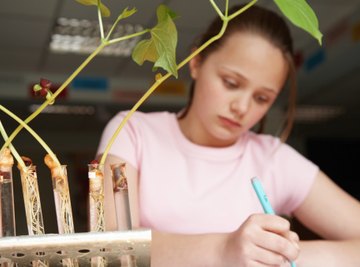

By the time a child reaches seventh grade, she is age 12 or 13, and she is curious about why and how things work. Children at this grade level are interested in experimenting with more challenging questions in science. There are a number of science projects appropriate for seventh graders that are more intellectually challenging, but still easy to do.
Remove Oil Pollutants in Water
This science project requires minimal steps and supplies. Use three jars to show three methods in which oil pollutants may be removed from water. Children can fill each jar up with water and add motor oil of half the amount of the water, to see how oil rises to the top. Children can use sand, a cheese cloth and a spoon as three methods to remove oil.
Photosynthesis Study
This science project requires setting three of the same plants in different lighting conditions and documenting how lighting affects their growth. Place one plant in a room with no lighting, the second plant in a room with some sunlight, but not direct sunlight, and the third plant in a room where it receives direct sunlight. Observe how quickly each plant grows and document information such as which plant grew the first leaf and flower.
Quickest Dissolving Pain Killer
When someone is in pain, you want to help eliminate pain quickly. This science project experiments which brand of painkiller dissolves the quickest. Select three brand name painkillers. Using three cups, add a quarter of a cup of water to each. Drop in one pain killer tablet into each cup at the same time. Observe and time how long each one takes to dissolve.
Salt and Its Effect on Water
This science project experiments whether salt prevents water from freezing. Fill three freezable and identical plastic cups with room temperature water halfway. In one cup, add two teaspoons of salt and stir. In another cup, put one teaspoon of salt and stir. Do not add any salt to the third cup. Label each cup. Place all three cups into the freezer overnight. In the morning, observe whether the cups were all frozen or if each cup varied in how much was frozen.
References
About the Author
Wendy Lau entered the communication field in 2001. She works as a freelance writer and prior to that was a PR executive responsible for health care clients' written materials. Her writing experience include technical articles, corporate materials, online articles, blogs, byline articles, travel itineraries and business profile listings. She holds a Bachelor of Science in corporate communications from Ithaca College.
Photo Credits
Ableimages/Lifesize/Getty Images