
Desert Turtle Facts

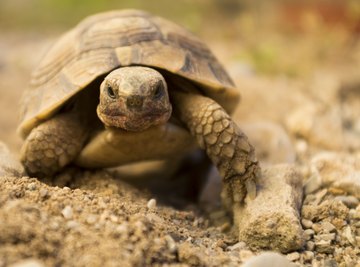
The desert turtle, also called a desert tortoise, is a land dweller that belongs to the family of turtles known as Testudinidae. This turtle lives in the Sonoran Desert and Mojave Desert of the southeastern part of California as well as southern portions of Nevada into Arizona and New Mexico. The herbivorous desert turtle can go over a year without water and survives in an environment where temperatures on the ground are greater than 140 degrees Fahrenheit.

  1. Habitat and diet

    • Desert turtles tend to live in the dry grasslands and gravel-filled desert washes below an elevation of 3,530 feet. These reptiles are cold-blooded and depend on the heat of the sun to remain active. The animal will eat grass, shrubs, herbs, cacti and wildflowers. Since rainfall in their environment is uncommon, the tortoise will actually dig small holes in the ground and return to them when it feels rain is on the way. The moisture gleaned through flowers and grass sustains the turtle, which in times of extreme drought releases a whitish paste from its system instead of urine.

    Turtle versus tortoise

    • A tortoise differs from a typical turtle in that its shell resembles a high dome and the legs are shaped like those of an elephant. The feet are rounded and designed for walking on the land, unlike the webbed feet on an aquatic species of turtle. Tortoise only go near water to bathe in it or to drink it rather than swim in it, which would be terribly hard considering the way the turtle's body is shaped.

    Burrowing

    • The shell of the desert turtle can reach as long as 15 inches. The front limbs of the turtle are much more muscular than the back ones are. This allows the reptile to dig in the dirt, which comes in handy since the desert tortoise spends as much as 95 percent of the time in some sort of underground hole. It escapes the searing heat of the day by staying underground and--in the colder months where freezes are a possibility--the turtle is dormant. Some burrows go many feet into the ground, while others are only long enough for the tortoise to gain shade from the sun.

    Reproduction

    • The tortoise can breed at any time of the year, but usually this occurs in the latter part of summer and early autumn. The females have the ability to store the sperm from the males and lay the eggs in the late spring. The female digs a nest and deposits the eggs. The heat in the soil incubates the eggs over a span of three to four months. Very few of the turtles that are hatched survive the rigors of desert life to become adults.

    Dangers

    • The desert turtle is a threatened species in the Mojave Desert due to a number of factors. In addition to predation of the smaller young by creatures such as ravens, kit foxes, Gila monsters, coyotes, and roadrunners, humans have taken many as pets. The competition from livestock for plants, the expansion of civilization into the desert, and death from respiratory diseases adds to their decline in numbers. Touching a desert tortoise or harming on in any manner is an illegal act.

Related Searches:

References

Comments

You May Also Like

  • Desert Turtle Information

    "Desert turtle" may refer to one of two species of the family Testudinidae--the Desert Box Turtle and the Desert Tortoise. Both are...

  • How to Take Care of a Desert Turtle

    The desert tortoise is sometimes referred to as a desert turtle, but there are big differences between a tortoise and a turtle....

  • Facts About California Desert Turtles

    The California desert turtle is also known as the California desert tortoise, the desert tortoise or the gopher tortoise because of its...

  • How to Care for Baby Desert Box Turtles

    Baby desert box turtles are delicate creatures that need time to develop. They need a stable environment in which to develop but...

  • Baby Desert Tortoise Pet Information

    The desert tortoise (gopherus agassizii) is native to the southwestern states, including California, Nevada and Arizona. As pets, the cute baby desert...

  • Unique Facts About the Mojave Desert

    The Mojave Desert is the smallest desert in North America. It is spread across parts of southern California, Nevada and northern parts...

  • Facts About Turtles

    Learning information about turtles can help pet owners keep their reptile friends from developing deformities. Discover facts about turtles, such as how...

  • At What Age Should Baby Desert Tortoises Be Hibernated?

    There is some debate on whether a hatchling (baby) desert tortoise should be hibernated. Some experts once recommended that they not be...

  • Facts About Desert Tortoises for Kids

    A tortoise is a lot like a turtle, except that it lives on dry land instead of in the water. No tortoise...

  • Information About Desert Animals

    Given the harsh conditions, a surprisingly large number of animal species call the desert home. The desert presents two particular survival obstacles...

  • Types of Desert Tortoises in New Mexico

    New Mexico is a state that consists mostly of desert but also has several mountainous ranges and rivers and lakes as well....

  • Facts About Pet Turtles

    Pet turtles may seem like an easy pet to keep, but they require a significant amount of care and attention. If properly...

  • List of Tortoises

    There are more than 70 different types of tortoises on planet earth, each of them having different sizes, colors and shapes. Tortoises...

  • How to Feed a Baby Desert Turtle

    Desert turtles are actually called desert tortoises because they live on land. The desert tortoise species is native to northern Mexico and...

  • Information on Baby Turtles

    Turtles are popular pets in the United States, and baby turtles are cute and nearly irresistible. They are commonly sold at pet...

  • How to Care For a Desert Tortoise

    The desert tortoise isn’t your ordinary pet, but it is among the few endangered species that you can legally adopt. These gentle...

  • What Does a Sonoran Desert Tortoise Eat?

    The Sonoran Desert tortoise (Xerobates "Gopherus" agassizii), often referred to simply as the desert tortoise, is one of three tortoise species found...

  • What Foods Does a Baby Desert Turtle Eat?

    What Foods Does a Baby Desert Turtle Eat?. Captive baby desert turtles, actually tortoises, are often susceptible to deformities due to a...

  • About Animals of the Sonoran Desert

    Covering a huge portion of southwestern Arizona as well as the entire southeastern tip of California, the Sonoran Desert extends well into...

  • Red-Footed Tortoise Facts

    The red-footed tortoise draws its name from the red and orange scales found on it's feet. Discover facts about red-footed tortoises with...

Related Ads

Featured