
What is energy and where does it come from? In everyday language, energy is some undefinable but desirable quality that allows you do do things like exercise, complete class assignments and do your job. In physics, it's a force multiplied by a distance, and it is expressed in the same units as work and heat. In practical terms, it's what human societies rely on for warmth, light, transportation, manufacturing and other processes that separate people today from those who lived in prehistoric and early historic times.
These days, energy is also controversial – what isn't? – thanks mainly to the issue of climate change. The burning of fossil fuels, mainly coal, has been firmly established as a leading contributor to human-caused global warming owing to the carbon dioxide (CO2) released into the atmosphere during the combustion process. But the world needs to produce a great deal of energy to maintain modern personal and commercial standards of living. Fortunately for the health of the environment, other sources of energy are being explored with increasing vigor as the planet inexorably becomes more and more affected by the ravages of climate change.
Sources of Energy
Generally, energy production comes from two primary sources; these are fossil fuels and clean energy. Secondary sources come from primary sources; one example is electricity. In the U.S., energy consumption is usually given in kilowatt-hours, or kWh. This unit is equal to 3.6 million joules, with the joule, or newton-meter, being the standard unit of energy in physics. Other common units are the erg, the British thermal unit and the calorie. (Trivia: The "calorie" you see on nutrition labels is actually a kilocalorie, or 1,000 "real" calories.)
The terms "clean energy" and "renewable energy" are often used interchangeably. This is not strictly accurate because, as you'll see, while nuclear power is a form of clean energy, whether it can be classified as renewable is open to question. Regardless, forms of clean energy include – along with nuclear power – solar power, wind power, hydropower, geothermal energy and bioenergy.
Renewable Energy Explained
A meaningful list of renewable resources for energy production in the 21st century would include biomass (e.g., wood and wood waste, municipal solid waste, landfill gas and biogas, ethanol and biodiesel); hydropower, or water power; geothermal energy, which comes from deep inside the Earth; and wind and solar power. These are called "renewable" because they arise from a supply that is in theory inexhaustible. That is, while the Earth is expected to one day yield its last ounce of natural gas and its final ounce of coal, the idea of sunlight, wind and rivers disappearing altogether is – one hopes, at least! – senseless.
Until the middle of the 1800s, America derived the energy it needed from burning wood. Because the U.S. population was comparatively low and most of this energy was for heating, light and cooking, with machines such as cars and air conditioners still a long way off, wood was enough to do the job. From the late 1800s until the early 21st century, fossil fuels (coal, oil and natural gas) served as the nation's energy source. Until the 1990s, the main renewables – a term that was more theoretical than real until recent decades – were hydropower and solid biomass; today, biofuels, solar power and wind energy all play serious and ever-growing roles.
In 2017, renewable energy provided about one-ninth of total U.S. energy utilization. 57 percent of consumption was in the form of electric power, and about one-sixth was generated from renewables.
Renewable energy is important for reducing greenhouse gas emissions because it lowers dependence on fossil fuels. While coal, gas and petroleum together are the longtime undisputed worldwide energy champion, the consumption of biofuels and other non-hydroelectric renewables was more than twice as high in 2017 as it had been at the onset of the 21st century. This trend was spurred by a combination of formal regulatory action and financial incentives for companies to develop renewables. This trend of increasing non-hydro biofuel utilization is expected to continue through 2050.
Energy From Fossil Fuels
Though something of a persona non grata in the energy world nowadays, oil, natural gas and petroleum remained the leading sources of energy in the U.S. and globally as of 2018. The combustion of these fuels is responsible for 75 percent of of carbon dioxide emissions since the end of the 20th century.
Fossil fuels were formed when prehistoric plants and animals perished and, over a period of millions of years, were buried and crushed under layers of rock. Mainly as a result of mechanical compression, different types of these fuels formed depending on local circumstances, such as what carbon-containing matter was present, how long it was buried and what the temperature and pressure conditions were at the time. Fossil fuel industries drill (oil and gas) or mine (coal) for these energy sources, and then burn them to produce electricity or modify them for use as fuel for heating purposes (e.g., furnace oil) or transportation (e.g., gasoline).
Energy From Biomass
Biomass refers to formerly living matter, that is, plants and animals. Biomass energy sources include wood-processing wastes, which can be burned to heat buildings, produce process heat in industry and generate electricity; agricultural waste materials, which can be burned as a fuel or converted to liquid biofuels; some garbage, which can be burned to generate electricity in power plants or converted to biogas in landfills; and even manure and sewage, which can be converted to biogas.
Energy From the Sun
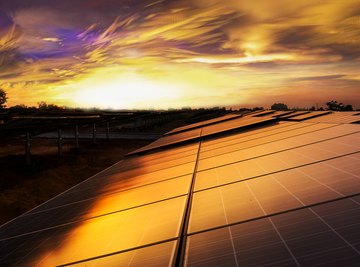
The sun has obviously been a source of energy for all living things throughout human history. More recently, people have developed the ability to harness this energy and put it to various modern uses. Solar thermal energy systems are used today to heat water for use in homes, buildings and whirlpools; warm the the inside of homes, sheds and greenhouses; and heat up liquids to the very high temperatures required in solar power plants.
Solar photovoltaic systems are used to convert sunlight into electricity. Photovoltaic, or PV, cells convert sunlight into electricity. Some of these can power small devices such as calculators and watches, while large arrays of PV cells can produce enough electricity for a typical house. Some of these power plants have massive arrays of PV cells spanning multiple acres, and these are large enough to service the electricity needs in thousands of homes.
Energy From Wind
During daylight hours, air above land heats up more quickly than air over water. Air over land expands and rises as it heats up, and and heavier, cooler air flows in to take its place, creating wind. At night, the winds reverse direction. Similarly, the atmospheric winds that circle the Earth are created because the land near the equator is warmer than the land near the poles. Wind power, captured by windmills (often in large arrays) is used mainly for electricity generation
Nuclear Power
Nuclear power is an example of energy that is "clean" and is considered renewable by some sources, yet it is highly controversial in its own right. Since the worldwide supply of uranium, the material used in nuclear power plants, is finite, nuclear power is typically lumped in with fossil fuels and classified as nonrenewable.
In any case, nuclear power provided 20 percent of the energy in the U.S. as of 2018, having been in use for over 60 years. Because of their role in indirectly helping to reduce carbon emissions, "nuke plants" remain a mainstay in the U.S. as well as abroad. Because of well-publicized accidents and scares over the years at nuclear power plants, many people remain leery of this source of energy, but the scientific consensus favors further development in this area with a focus on safety.
References
About the Author
Kevin Beck holds a bachelor's degree in physics with minors in math and chemistry from the University of Vermont. Formerly with ScienceBlogs.com and the editor of "Run Strong," he has written for Runner's World, Men's Fitness, Competitor, and a variety of other publications. More about Kevin and links to his professional work can be found at www.kemibe.com.