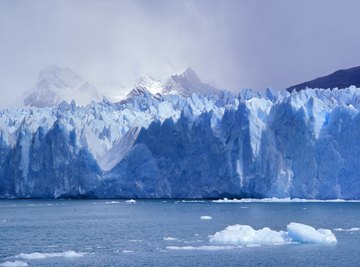

Due to the hot-button, politically charged nature of the climate change debate, agreed-upon facts regarding the melting of the polar ice caps can be hard to find. However, scientists are constantly researching the phenomenon and publishing peer-reviewed reports based on their work.
Unprecedented Ice Sheet Melting
Massive ice sheets at opposite ends of the Earth are melting at an unprecedented rate, according to Veit Helm and other glaciologists at the Alfred Wegener Institute in Bremerhaven, Germany. Using satellite mapping technology, the German team found that ice sheets in Greenland and Western Antarctica, spanning thousands of miles, are losing 500 cubic kilometers (about 120 cubic miles) of ice per year. Angelika Humbert, one of the members of the research team, told The Guardian that the volume of loss in Greenland has doubled and that in the West Antarctic, ice sheet loss has tripled, since 2009.
Shrinking Sea Ice
In addition to the massive Greenland ice sheet, the Arctic also has a large volume of sea ice that expands throughout the winter and contracts throughout the summer. In 2014, Arctic sea ice shrank to its sixth-lowest level since record keeping started in 1978, according to data released by the National Snow and Ice Data Center. Lou Leonard, vice president for climate change at the World Wildlife Fund, told USA Today that the data shows a "catastrophe" taking place in the Arctic. NASA scientists have noted that sea ice data is not clear enough to show a long-term climate trend.
Potential Sea Level Rise
While sea ice melt would not cause sea levels to rise around the world, the melting of polar ice sheets would, and research has shown that sea levels did rise during the last decade. From January 2003 to December 2010, ice cap melting essentially contributed to a 1.06-millimeter rise in sea levels, according to a study from researchers at the University of Colorado, Boulder.
Shipping Lanes
While the increased melting of polar ice is being seen as a slow-moving disaster by some, it is being seen as an economic opportunity by others. The waters around the North Pole have lost so much sea ice in recent years that nations are beginning to use these newly opened water lanes for shipping. In 2013, Russia announced that it would be sending naval patrols along newly opened shipping lanes in its Arctic Ocean territory. The announcement came after a flagship of the Russian fleet, the Pyotr Velikiy, sailed across the Northwest Passage -- essentially the stretch of water along Russia's Arctic coast.
References
About the Author
Brett Smith is a science journalist based in Buffalo, N.Y. A graduate of the State University of New York - Buffalo, he has more than seven years of experience working in a professional laboratory setting.
Photo Credits
Ingram Publishing/Ingram Publishing/Getty Images