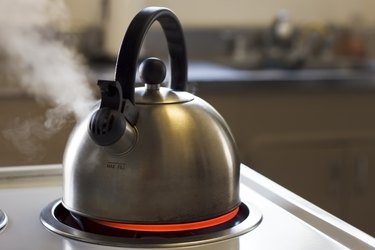
The dynamics that cause a tea kettle to whistle are complex enough to have stumped Lord Raleigh, author of a foundational physics treatise on sound. The fact that we now understand them doesn't change what you need to do to make a tea kettle whistle, though, and it's basically very simple. You must reduce the opening of the tea kettle through which steam escapes to one or two small holes. If your tea kettle doesn't come equipped with a spout cover, you can usually buy one; if you can't find a suitable one, it's easy to make your own.
Step 1
Measure the outside diameter of your tea kettle's spout, using a ruler.
Video of the Day
Step 2
Pick up a copper pipe cap from the local home improvement store or hardware plumbing department with an inside diameter 1/4- to 1/2- inch larger than the spout's outside diameter. For example, if the outside diameter of the spout is 1/2 inch, purchase a 3/4- or 1-inch copper cap.
Step 3
Glue something to the top of the cap to use as a handle when removing the cap from the spout while the water is boiling. It could be a decorative piece of metal or a keyring placed on edge. Use two-part epoxy glue to secure the handle to the cap.
Step 4
Drill a single 1/8-inch hole through the side of the cap near the top. Don't drill it on the curved end of the cap, or it will blow steam toward your hand as you're removing the cap from the spout. It should be as close as you can get it to the point at which the top of the cap starts to curve.
Step 5
Apply a bead of heat-resistant silicone caulk around the inside rim of the cap and let the caulk cure. Put the cap on the spout -- it should fit tightly. If you can't get it on, trim some of the caulk with a knife. If it fits loosely, add more silicone.
Video of the Day