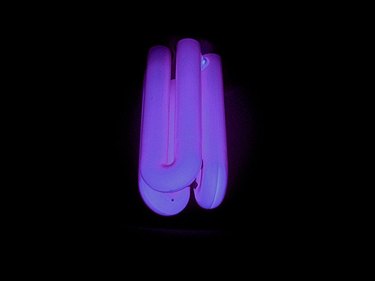
If you have ever watched a forensic crime show on television where investigators were searching for evidence using a light source that is bluish-purple in color, then you've seen a black light. Ever had a marker stamp put on the back of your hand, and it appeared nothing was there until you were instructed to place it under a certain light source that made the mark suddenly glow? That was another black light.
The inventor of the black light was William H. Byler, and he was a prolific inventor in the luminescent materials industry.
Video of the Day
Video of the Day
Inventor
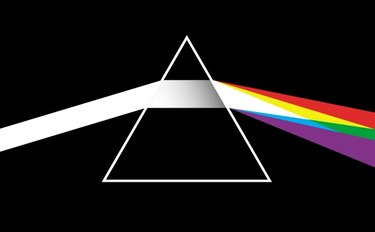
William H. Byler is credited with inventing the black light in 1935, and according to the University of Central Missouri, Byler graduated there in 1927 with a major in chemistry and physics. By 1937, he had earned his doctorate at the University of Missouri, and went to work for General Electric Corporation as a research scientist. After two years at GE, Byler became director of research at the U.S. Radium Corporation. At U.S. Radium, Dr. Byler was awarded several patents over the course of a 32-year history.
During World War II, Dr. Byler was instrumental in radar and infrared spectrum research because of his study of phosphors allowing our Allies to win the war. Air travel is much safer today because of this early radar. His contributions to medical science have resulted in technology that has reduced our exposure to harmful x-rays. And our environment has benefited from Dr. Byler's work with detection methods such as atmospheric pollution and weather forecasting, based again on radar.
Dr. William H. Byler devoted his entire life to the study of luminescent chemicals which paved the way for many advances in technology then and now. These phosphors are used to coat the glass of many different kinds of screens.
Black Light
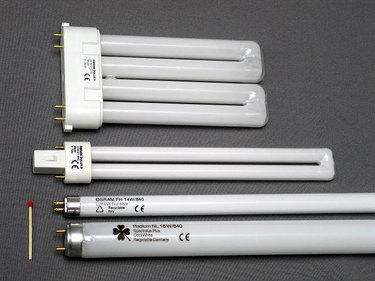
Black lights are fluorescent lamps with a couple of modifications, 1) the absence of a phosphor coating on the inside of the glass tubing, and 2) the color of the glass tubing.
Black lights get their unique appearance from the way in which light is emitted from the lamp. Fluorescent lights are hollow tubes containing electrodes on each end. Inside these tubes is a small amount of mercury vapor, and the clear glass is coated with a white phosphor substance. When a high voltage current jumps through the tube, it interacts with the low-pressure gas causing the lamp to glow. When this energy acts on the phosphor coating, a cool white light is emitted.
When high-voltage is sent through mercury vapor, it gives off green, violet, blue and invisible ultraviolet light. If the white phosphor-coating on the inside of the glass tube was removed, you would not see white light. Instead, you would see a blue-green glow. Black lights get their appearance from the color of the glass. The blue dye used in the glass absorbs the light spectrum with the exception of a little ultraviolet light that escapes through the dye. This shows up as a blue-purplish color. If the dye did not have any impurities in it, a black light would not have any color at all. When you turn it on, the lamp would be totally black. The same effect can be obtained from an incandescent bulb using a filter covering it. These are very weak at producing the black light effect of making certain objects appear to "glow."
Light Spectrum
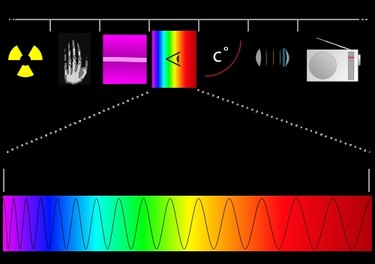
The light spectrum of electromagnetic energy that we humans can see encompasses only a narrow part of it between infrared and gamma rays. These electromagnetic waves range between extremely long to very short ones. The shortest ones are believed to be smaller than an atom. The longest ones are believed to be the size of the universe. The bandwidth we see in is between 400 to 700 nanometers. A nanometer is a billionth of a meter to give you an idea how small that is. Anything above or below that we can't see. Black light energy is between 320 and 400 nanometers.
Wood's Glass
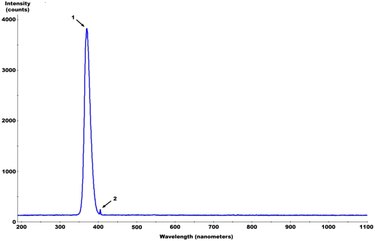
Instead of dyes being used in the making of black lights, there is a glass that was developed by Robert Williams Wood (1868--1955) that produces the same effect as if the glass were dyed. However, it is expensive, and not feasible for production purposes. The special glass is called Wood's glass.
"Wood's Glass" is prepared using nickel-oxide in the recipe of the glass giving it a blue-purple color. It blocks most all of the visible light over 400 nanometers. A phosphor is also used in the inner surface of the glass lamp but differs in the composition of that used with regular fluorescent lamps. In fact, there is a blend of different phosphors that are used to produce the black light effect. One of the phosphor blends uses europium doped strontium fluoroborate.
Uses
Black lights are used in a number of applications, including the entertainment industry and forensic science. It is also used in spotting counterfeit money, motel and hotel cleaning (especially in bathrooms), art fraud, scorpion detection, science projects, air conditioner leaks, UV nail curing, fluorescing minerals, particulate contamination, poster lighting, bio-terrorism training, inspecting dairy products, criminology, photography, diamonds irradiated for increased clarity making the diamond more expensive, and mold inspection, to name a few.
William H. Byler's contribution to the world with his research on phosphors, and invention of the black light among many other things, has improved the quality of our lives, as well as extended it.