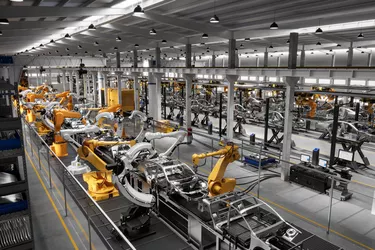
Modern manufacturing includes the process necessary for the production of a product and its components. Prior to the Industrial Revolution, the origin of manufacturing simply meant creating products or goods by hand. Most families worked from their farms or homes. The Industrial Revolution sparked major changes and brought inventions we still use today, including the sewing machine and light bulb. It laid the foundation and paved the way for the manufacturing industry as we know it.
The Industrial Revolution
Video of the Day
The Industrial Revolution brought a change in the way goods were manufactured. Instead of producing items by hand at home, manufacturers began using machines to produce multiple quantities in less time.
Video of the Day
In the late 18th century, the Industrial Revolution reached the United States. Textile manufacturing, glass making, mining and the agriculture industry all underwent significant changes. The spinning wheel, water wheel and steam engine took over the role of the artisans. Since items were cheaper and quicker to produce, the supply grew. The demand was greater than the supply, which allowed factories to open.
Textile factories multiplied across the United States. Not only did men and women work in factories, but children did as well. The Factory Act of 1833 was established, restricting the hours children could work and setting certain standards for factories.
Introduction of Assembly Lines
In 1908, Henry Ford and Charles Sorensen arranged all the key elements of a manufacturing system, including machines, tools, products and people to manufacture the Model T automobile. Ford developed the assembly line, assigning specific tasks to each person in the line to get the cars built fast and efficiently. Between 1908 and 1927, Ford manufactured around 15 million Model T cars. He even paid his employees wages high enough to afford the cars, making them consumers as well.
Consider Also: Average Salary of a Ford Master Mechanic
Lean Manufacturing System
The Toyota Motor Corporation developed the concept of lean manufacturing in 1948. The goal was to improve production flow by identifying and eliminating waste. This approach was very different and required more persistence. Over the years, Toyota has worked towards improving the system.
Consider Also: Electric Cars Will Save You Money – With Some Caveats
The lean manufacturing system remained mostly confined to Japan until the 1970s. During that time, the automobile manufacturers in the United Kingdom also began adopting lean manufacturing systems of production. In the 1990s, the concept of lean manufacturing began spreading outside the automobile industry. It has since been used in aerospace, consumer electronics, construction, healthcare, food manufacturing and meat processing.
The Use of Robotics
The Westinghouse Electric Corporation created the Televox robot in 1926. It was first robot actually put to "useful work." Televox was a robotic maid used for housekeeping duties. In 1937, the corporation built a smoking, talking and walking humanoid robot called Elektro. It was showcased during the World Fairs of 1939 and 1940.
Unimate, the first industrial robot, was created in the 1950s. In 1961, it worked on the General Motors assembly line. The creator, George Devol, worked with Joseph Engelberger to develop Unimation, the world's first robot manufacturing company.
In 2008, the U.S. Air Force 174th Fighter Wing became the first all-robot attack squadron, when they shifted from piloted planes to remote-controlled reaper drones. In 2013, collaborative robots, also referred to as COBOTs, were introduced. These robots were designed to work alongside humans.
Consider Also: Yes, Your Roomba Has a Personality