
Composition
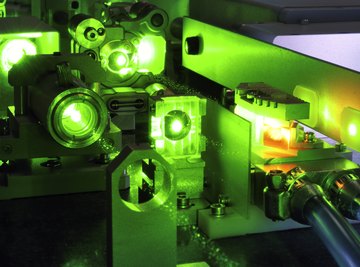
A CO2 laser is a type of gas laser. In this device, electricity is run through a gas-filled tube, producing light. The ends of the tube are mirrors; one of which is fully reflective and the other which lets some light through. The gas mixture is generally comprised of carbon dioxide, nitrogen, hydrogen and helium. Light produced by CO2 lasers is invisible, falling in the far infrared range of the light spectrum.
Production of the Laser Beam
When stimulated by an electric current, nitrogen molecules in the gas mixture become excited, meaning they gain energy. Nitrogen is used because it can hold this excited state for long periods of time without discharging the energy in the form of photons, or light. The high-energy vibrations of the nitrogen in turn excite the carbon dioxide molecules. At this point, the laser achieves a state called population inversion, the point at which a system has more excited particles than non-excited ones. For the laser to produce a beam of light, the nitrogen atoms must lose their excited state by releasing energy in the form of photons. This happens when the excited nitrogen atoms contact the very cold helium atoms, which causes the nitrogen to release light.
Discharge of Laser Light
The light produced is very powerful compared to normal light because the tube of gases is surrounded by mirrors, which reflect most part of the light traveling through the tube. This reflection of light causes the light waves being produced by the nitrogen to build in intensity. The light increases as it travels back and forth through the tube, only coming out after becoming bright enough to pass through the partially-reflective mirror.
Beam Power and Wavelength
Light from a CO2 laser is powerful enough to cut many materials, including cloth, wood and paper; the most powerful CO2 lasers are used for machining steel and other metals. Although the highest-powered CO2 lasers run over 1,000 W, those used for machining are generally between 25 and 100 W; by comparison, laser pointers are a few thousandths of a watt. Because it's in the infrared, it has a very long wavelength, around 10.6 micrometers; it is much longer than visible light, which runs between about 450 and 700 nanometers. As continuous lasers go, the CO2 type is the most powerful in production.
References
About the Author
David Scott has been a firefighter for the Seattle Fire Department's Technical Rescue Team for almost 20 years. He has been writing primarily since 2005, but did author the book, "The White River Ranger District Trail Guide" in 1988. In addition to his work for Demand Studios, Scott spends much of his time writing poetry and a novel.