Life Cycles of the Coral Reef

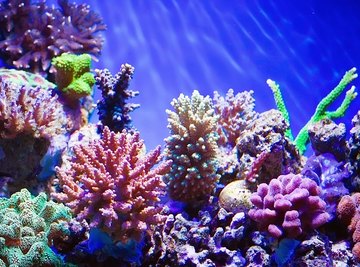
Coral are found in every ocean in the world, although most people think of stunning tropical coral reefs full of marine life. Coral reefs, or colonies of coral polyps, create the largest biological structures on Earth. Although more than 6,000 species of coral are known, coral share some physical characteristics--tentacles that emerge from the top of a tube-shaped body. The life cycle of a coral reef is important to understand, as coral reefs are host to almost 25 percent of all marine life.

  1. Description

    • Coral reefs are made up of both living creatures and limestone skeletons. Adult coral, also known as polyps, whip their stinging tentacles through the water hoping to catch zooplankton. The tentacles pull the food toward the simple mouth atop the tube-shaped body. During the course of its life, the polyp produces calcium carbonate, which is secreted from its living tissue. The calcium carbonate builds up around the tube, creating an exoskeleton. When the coral dies, the exoskeleton remains, and new coral polyps attach to it, starting the process all over again. Many coral reefs are thousands of years old.

    Eggs

    • An adult polyp will develop eggs or sperm within its body. Depending on the lunar cycle and triggers of night and day, coral somehow know to release both at the same time, ensuring higher success for fertilization. Most coral species spawn in late spring, a few days after the full moon. Both eggs and sperm are released into the water, where fertilization takes place. When eggs and sperm come together, the fertilized eggs drift along until larvae emerge.

    Planula

    • The larvae, known as planulae, swim toward the ocean bottom, using the current to drift as well. Planulae are a prime food source for many sea creatures, so of the millions that develop, many never grow to maturity. Planulae that survive attach themselves to something solid, whether an existing coral reef, a rock or sunken ship. Once attached, it only takes a few weeks for the planulae to develop into polyps.

    Polyp

    • Polyps naturally form colonies by a process known as splitting. This reproductive process simply requires a grown polyp to divide, creating an identical offspring. The new polyp usually stays attached to the parent, and will share the same characteristics. The new polyps then divide, creating third-generation polyps. Thousands of polyps can be created in a short amount of time. Thus, coral reefs grow by both sexual and asexual reproduction.

    Growing Reefs

    • As the polyps die, the calcium carbonate casings remain, only to be built upon by new polyps. In a coral reef, just the topmost segment contains living, feeding coral polyps. Underneath is an empty calcium carbonate network. The coral reef structure is somewhat fragile, with everything from chemicals to fluctuating temperatures threatening both the polyps and the calcium carbonate structure.

Related Searches:

References

Comments

You May Also Like

  • How Do Nutrients Cycle in Coral Reefs?

    Corals are marine structures composed of millions of small organisms called polyps. According to the National Oceanic and Atmospheric Association, polyps secrete...

  • Life Cycle of Brain Coral

    Life Cycles of the Coral Reef. Coral are found in every ocean in the world, although most people think of stunning tropical...

  • Plant Life in the Coral Reefs

    Coral reefs are living ecosystems with an abundance of marine animal and fish species. Plants such as turtle grass, algae and mangroves...

  • Anthozoa Life Cycle

    If you've ever bought a coral necklace, surfed a reef break or stuck your finger in an anemone, you might be familiar...

  • The Effects of Coral Bleaching on Marine Life

    The tiny invertebrates that make up coral reefs are very sensitive to the temperature and chemistry of the water surrounding them. A...

  • Life Cycle of Cnidarians

    Cnidarians make up the scientific phylum that includes jellyfish, anemones and corals. How the life cycle is continued by these creatures that...

  • Characteristics of Coral Reefs

    Coral reefs are shallow-ocean habitats that are filled with sea life. The massive structure that the coral reef is comprised of is...

  • Facts About Brain Coral

    Brain coral includes several varieties of coral that are generally round or oval in shape with grooved or smooth ridges meandering across...

  • Life Cycle of Obelia

    Obelia live in oceans throughout the world. Though they may appear to be plants they are, in fact, animals. Obelia are members...

  • Life Cycle of a Stercoralis

    Strongyloides stercoralis is a small, thin, white nematode, or roundworm, that infects the intestines of human beings. Most commonly this type of...

  • The Importance of Coral Reefs

    Coral reefs support an enormous diversity of marine life and play a large role in marine ecosystems and in the Earth's biosphere...

  • Life Cycle of Pond Fish

    The life cycle of pond fish is an interesting one, especially as pond fish will breed regularly when the right conditions are...

  • Life Cycle of the Aurita

    Moon jellies are among the most commonly known of the medusan jelly fish. Aurelia aurita is the moon jelly native to the...

  • Life Cycles of Sea Anemones

    A sea anemone is an invertebrate polyp with a cylinder body and a mouth encircled by tentacles, according to the Microsoft Encarta...

  • Hydroid Life Cycle

    A hydroid or a hydrozoan are small, plant-like animals related to jellyfish, corals and sea anemones. There are about 2,000 species of...

  • Top Ten Largest Coral Reefs

    Top Ten Largest Coral Reefs. Coral reefs are the habitats for coral. They cover about 0.2 percent of the ocean floor, but...

  • About Caribbean Coral Reefs

    The Caribbean coral reefs are a diverse and unique ecosystem. They provide habitats for a variety of marine species, both plant and...

  • Parrotfish Life Cycle

    Parrotfish are a mostly tropical species of fish that prefer the shallow coral reefs of the Red Sea and Atlantic, Indian and...

  • Life Cycle of Red Worms

    Red worms, often used for home composting of kitchen scraps, go more properly by the name red wigglers, or Eisenia fetida. Reflecting...

Related Ads

Featured