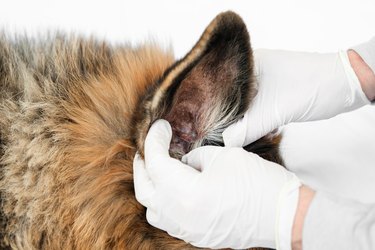
If your dog has a hard, lumpy, swollen spot or leathery growth on their ear, it could be a tumor. Because some malignant tumors may even prove fatal, it is important to have your dog's ear growth checked out by your veterinarian as soon as you notice it. There are several conditions that may cause ear tumors, and while most are benign tumors, some are cancerous tumors.

Video of the Day
This is one reason checking and cleaning your dog's ears regularly is an important aspect of pet health. Having a veterinary professional properly diagnose your dog's ear growth can mean the difference between life and death for your dog.
Video of the Day
Symptoms of ear tumors in dogs
An ear growth in a dog typically starts as a small mass or nodule in the ear that may be white, pink, or purple in color. Over time, the mass may grow, and if it gets large enough, it could block the entire ear canal. Cancerous tumors may also bleed.
There are several other symptoms of ear tumors that pet owners can watch for, although specific symptoms can vary depending on the cause of the ear growth. Some potential symptoms include:
- Recurring ear infections
- Itching the ear
- Ear inflammation
- Head shaking
- Ear discharge
- Smelly ear discharge
Tumors of the ear flap and external ear canal are more common in dogs than tumors in the middle or inner part of the ear. If the tumor is in the middle ear or inner ear, dogs may have other symptoms, such as:
- Head tilt
- Nystagmus, or eyes that dart back and forth
- Facial paralysis
- Loss of hearing
- Poor coordination
Causes of ear tumors in dogs
There are many potential causes of ear growth in dogs, and some breeds, such as cocker spaniels, are more prone to ear canal tumors than others. The reason is unknown, but it is thought that the underlying cause may be chronic inflammation, such as from recurring ear infections that affect many members of the breed.
Some conditions that cause ear tumors in dogs include:
- Lipomas, or fatty deposits
- Benign or cancerous tumors
- Warts
The underlying cause of many of these tumors is not fully understood, likely because many factors come into play, including genetics and environmental factors.
Diagnosis and treatment of ear tumors on dogs
If you find an ear growth or notice other symptoms, take your dog to the veterinarian right away for an examination. Your veterinarian will conduct a physical examination and may conduct additional testing to confirm the diagnosis. Some testing methods that your veterinarian may use include:
- Biopsy
- Fine needle aspiration
- CT scan
If the tumor is malignant, your veterinarian may conduct additional testing to see if the cancer has spread. This may include:
- X-rays
- Bloodwork
- Ultrasound
- Urinalysis

Lipomas in dogs
Usually benign, lipomas are characterized by softly rounded fatty masses just under the skin. When allowed to grow, they may become uncomfortable or painful for your dog and may need to be removed surgically. Rarely, lipomas may become cancerous and spread throughout your dog's body. If your dog has a lipoma, your veterinarian may suggest performing a fine needle aspirate to determine whether or not the tumor is cancerous.
Dog basal cell tumors
Basal cell tumors are common in middle-age to older dogs and are especially prevalent in certain breeds, including wheaten terriers, Kerry blues, and wirehaired pointed griffons. They usually appear on the head or neck and are usually benign. Because they may continue to grow and become infected, your veterinarian may suggest removing the basal cell tumor from your dog's ear.
Cutaneous squamous cell carcinoma in dogs
Cutaneous squamous cell carcinomas are usually found around the area of the head on older dogs. Standard poodles, basset hounds, and bloodhounds frequently develop these raised bumps or plaques, which may easily become ulcerated and infected.
Melanoma in dogs
Melanomas develop in the skin pigment of dogs and rapidly invade the areas surrounding the skin. The ear is not a common location for canine melanoma, but it may become malignant and spread into the blood system and organs of your pet. Melanoma should be treated surgically or with chemotherapy to prevent the spread of cancer.
Round cell tumors in dogs
These tumors may appear as a raised, round skin mass or lesion; open wound; or large mass. There are different types of round cell tumors, but the most common is the cancerous mast cell tumor. Plasmacytomas are another type of round cell tumor. They affect the plasma cells that appear on the head or limbs of a dog and appear as raised, round masses.
Your veterinarian may wish to biopsy a suspected plasmacytoma in order to make a proper diagnosis and begin treatment. Both mast cell tumors and plasmacytomas are treated by surgically removing the tumor. In some cases, follow-up treatment of chemotherapy or radiation therapy is also required.
Papillomas or warts on a dog
Papillomas (warts) are caused by a virus. They are usually not a cause for concern and often go away on their own without medication or treatment. They appear as benign, cauliflowerlike growths that blossom outward from a "seed" under the skin.
Ear hematomas in dogs
Hematomas are a common cause of lumps on a dog's ears. This is not a true growth but rather a collection of blood in the ear flap, or pinna. Ear infections are a common cause of ear hematomas because the itching causes the dog to scratch and shake their head excessively. This can cause the blood vessels in the ear flap to rupture, resulting in a hematoma. Other conditions that can cause the dog to scratch and shake their head, leading to an ear hematoma, include allergies, bite wounds, ear mites, and foreign objects in the ear.
Discuss potential treatment options with your veterinarian. Some options include:
- Surgery
- Draining the hematoma and injecting steroids
- Oral steroids
The bottom line
While most ear tumors are benign, others can be malignant and even fatal for your dog. Have your DVM examine your dog so they can diagnose the cause of the tumor and recommend treatment options, which may include surgery or chemotherapy.