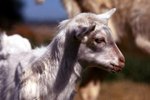
Lambs arrive after close to a five-month gestation period -- about 147 days. These baby sheep experience a high mortality rate among lambs, but good animal husbandry and management practices boost survival.
Newborn Lambs
Once born, the lamb should breathe immediately. If she doesn't, remove any traces of placenta on the mouth and nose, and rub the chest gently. You can also try blowing into the lamb's nose for breathing stimulation. Disinfect the navel with iodine as soon as possible to prevent infection. Provide the lamb and ewe with a clean, dry, draft-free shelter.
At the one-week mark, lambs should have their tails docked. This isn't done for cosmetic purposes, but to protect the lamb against fly strike, or maggot infestation, and for cleanliness. Unless intended for breeding purposes, male lambs should be castrated at this age.
Lamb Bottle-Feeding
For the first several weeks of life, lambs depend on their mothers as their primary food source. Since ewes often give birth to two or sometimes even three lambs, the smallest lamb often doesn't receive adequate nutrition. If that's the case, or if the ewe dies or is otherwise unable to nurse her offspring, you must bottle-feed the lamb. If the lamb didn't receive maternal colostrum, the "first milk" full of antibodies, you must feed it within 18 hours of the birth, but it should be fed as soon as possible. If you can't milk the ewe to provide colostrum for bottle-feeding, use a commercial colostrum supplement. If you have another ewe who gave birth the same day, you can use her colostrum.
If possible, find another ewe to take on the lamb. If that's not an option, use commercial sheep milk replacer. Bottle-feed newborn lambs at least four times daily. Within a week, you can reduce feedings to twice daily and feed them out of a pail. You can also start them on 16 to 18 percent protein lamb feed at that age, completely weaning them off milk replacer by the age of 3 weeks.
Lamb Vaccination Schedule
Lambs receive temporary immunity against certain disease from the ewe's colostrum. Good husbandry practices include vaccinating the pregnant ewe about one month before delivery. Between the ages of 3 and 4 weeks, a lamb should receive a clostridium perfringens and tetanus shot, included in the same vaccination. A booster is necessary three to four weeks later. Most sheep owners vaccinate their stock themselves. The vaccinations are given subcutaneously, generally in the ovine equivalent of the armpit.
Lamb Conditions and Diseases
Lambs are vulnerable to various diseases, and many of them succumb to these ailments. The viral contagious ecthyma, usually referred to as sore mouth, causes ulceration on the mouth and interferes with nursing. A lamb can starve to death without human intervention. Pneumonia often kills lambs, especially those with no or inadequate colostrum intake. Diarrhea, or scours, is another early lamb killer.
Lambs aged 1 month or more may develop coccidiosis, infection with the protozoan coccidia. Symptoms include black diarrhea and appetite loss, but the lamb can be saved with treatment. Entropion, a genetic condition in which the eyelid turns under, is common in lambs. The animal requires treatment, often consisting of removing part of the lower eyelid, or blindness can result.
References
- Virginia Cooperative Extension: Newborn Lamb Management
- Sav-a-Caf: Lamb Care -- Volume 3.01 Tips for Hand Raising a Healthy Lamb
- Ontario Ministry of Agriculture, Food and Rural Affairs: Care of the Newborn Lamb
- University of Minnesota Extension: Sheep Diseases
- University of Maryland Extension: CD-T Vaccinations
- American Veterinary Medical Association: Docking of Lambs' Tails
Photo Credits
-
Ralf Nau/Digital Vision/Getty Images
Writer Bio
Jane Meggitt has been a writer for more than 20 years. In addition to reporting for a major newspaper chain, she has been published in "Horse News," "Suburban Classic," "Hoof Beats," "Equine Journal" and other publications. She has a Bachelor of Arts in English from New York University and an Associate of Arts from the American Academy of Dramatics Arts, New York City.