The Life Cycle of a Snail

The Life Cycle of a Snail thumbnail
The Life Cycle of a Snail

Snails were likely slowly traveling the earth 600 million years ago. A type of mollusk, snails are hermaphrodites, meaning that each individual can produce both sperm and eggs. A snail can live to be 15 years of age and possibly as old as 25 years.

While snails will mate once a month if weather conditions are suitable, their continuous courting, mating and reproducing is interrupted by cold temperatures during which the snail hibernates, covering its body with a layer of mucus to prevent it from drying out. In severe drought, even in summer months, snails may also go into hibernation.

There are more than 200,000 species of snails in the world, but the life cycle is fairly standard across the various types.

  1. Courting

    • The rituals that snails go through before mating can last for a couple of hours to a half-day. Because snails do not hear, the courtship involves lots of touching, and partners cover each other in slime before mating. In some species the snails even appear to spend long moments in passionate kisses.

    Mating

    • The reproductive organs are on the side of the snail's body. Once they have mated, the snails leave each other. Because both snails have male and female reproductive parts, both partners can conceive up to 100 eggs after mating. Snails may mate as often as once a month.

      In a few species, if necessary, they can self-fertilize.

    Eggs

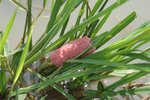
    • The eggs look like tiny chicken eggs and, depending upon the species, can be hard-shelled or soft. Most species deposit their eggs into moist soil where they will stay for up to 4 weeks before hatching. However, many eggs do not survive to hatch because they are washed away by rain and garden hoses, eaten by predators or consumed by baby snails that hatch first.

      There are a few species that actually hold the eggs within their bodies until they are ready to hatch.

    Baby Snails

    • As the young snails emerge, complete with shells, they are often eaten by predators. The baby snail needs to consume calcium quickly because its shell is very fragile. Calcium hardens the shell, offering the vulnerable baby more protection.

      Because of the need for calcium, out of instinct, the baby will eat the shell of the egg from which it hatched as well as unhatched eggs nearby.

    Adult

    • The snail will continue to grow and, in some species of snails, will not reach reproductive maturity for nearly 2 years.

      The shell with which the baby is born will stay with it for life. By the time it is an adult, the part of the shell with which it was born will be in the middle of its back. Within the snail's shell, rings grow that can help to determine its age.

Related Searches:

References

Resources

  • Photo Credit http://www.sxc.hu/photo/1181451

Comments

You May Also Like

  • Life Cycles of Plants for Children

    Plants are an important part of Earth's ecology. They are primary producers, able to make their own food using energy from the...

  • Gastropod Life Cycle

    The Gastropod family of organisms includes both snails and slugs, including marine slugs or sea slugs. The main aspects of the life...

  • Life Cycle of a Gilled Snail

    Gilled snails (Prosobranchs) comprise a large family of aquatic snails that have gills for breathing and are found around the world. The...

  • Apple Snail Life Cycle

    Apple snails are large freshwater snails. The apple snail is native to South America, Central America, and the southern United States. These...

  • Life Cycle of a Brown Garden Snail

    The brown garden snail, or Cantareus asperses, was introduced to the United States to be served as the French delicacy escargot, according...

  • Life Cycle of the Freshwater Snail

    There are hundreds of species of snail. They can be found on land, in saltwater and in freshwater. All species of snail...

  • The Life Cycle of Bilharzia

    The bilharzia (or schistosomiasis) is a group of parasitic worms that causes all sorts of problems in the human body. The worms...

  • Mollusk Life Cycle

    Mollusks make up a scientific phylum of soft-bodied creatures, most often enclosed in a shell. The mollusk's body contains the digestive and...

  • The Life Cycle of Schistosoma

    Schistosomes are a form of parasitic worm that infect both an intermediate and final host. They are 7 to 20 mm in...

Related Ads

Featured