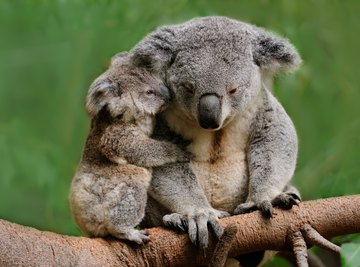
Birth, growth, reproduction and death represent the four stages of the life cycle of all animals. Although these stages are common to all animals, they vary significantly among species. For instance, while insects, birds and reptiles are born from an egg, mammals develop as embryos inside the mothers’ bodies.
Most animals appear similar to their adult counterparts at birth. Some types of animals, however, including most insects and most amphibians, go through radical transformations during their growing stage. This process is called metamorphosis. The entire life cycle of an animal can last from only several days or weeks, as it happens with many insects, to more than a century, as in the case of some tortoise species.
TL;DR (Too Long; Didn't Read)
The four stages of the life cycle of an animal are birth, growth, reproduction and death. All animal species go through these stages, but they manifest differently across the animal kingdom. Mammals are oviparous because their embryos develop inside the mothers’ wombs, while other types of animals are viviparous because their embryos develop in external eggs. Some reptiles are called ovoviviparous because their embryos develop inside eggs that remain inside their mother body until they hatch.
Most animals appear similar to their adult counterparts at birth, but some types of animals, including most insects, go through a radical transformation called metamorphosis during their growing stage. Some animals can reproduce asexually, but most animals reproduce through sexual reproduction, which requires male and female gametes. After aging, animals end their life cycles by dying. Animals’ life spans last from a few days to more than a century.
Types of Gestation
Animals are called viviparous when born from the mother's womb, or oviparous when developed inside an egg external to the mother’s body. Some reptiles are called ovoviviparous because their embryos develop inside eggs that remain inside their mother body until they hatch. Embryonic development is similar in most vertebrates, but it can last from 19 days in mice to well over a year in large mammals, such as giraffes, whales and elephants.
Early Growth
Before reaching sexual maturity or adulthood, animals pass through a growing stage. Some species, most common among invertebrates and amphibians, go through metamorphosis during the growing period. Metamorphosis includes larval and pupal stages. Butterflies, grasshoppers, mosquitoes, frogs and salamanders are some examples of animals that undergo metamorphosis. Hormones, such as somatotropin, induce growth in animals.
Creating New Life
Animals reproduce in sexually or asexually. While sexual reproduction involves male and female gametes - the spermatozoid and the ovule - asexual reproduction depends on a single individual to generate new life. Hydras, sponges, starfish and flatworms of the class Turbellaria, know as planarians, can reproduce asexually, but most animals depend on sexual reproduction to reproduce.
The End of Life
After aging, animals end their life cycles by dying. Loss of hearing and sight, lack of energy, body weakness and illnesses are some signs of aging and often precede the natural death of an animal in the wild. Predators are more likely to die natural deaths, while prey species are likely to succumb to attack when they become too old to defend themselves properly. Different species have distinct lifespans. Among birds, parrots have the longest lifespans, living up to 100, while hummingbirds generally die before they reach 10 years of age.