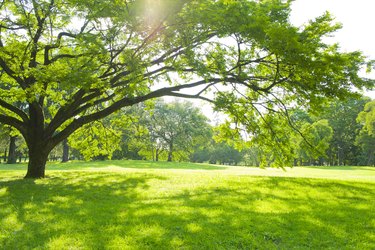
Seeking refuge in the shade on a hot day is even more soothing when you sink your feet into lush grass. Several types of grasses can be grown in shade, if the growing area gets at least four hours of sun a day. Seed mixes of cool-season grasses selected for shade are readily available and should be sown in the early fall, no later than mid-September. Finding shade-tolerant warm-season grasses is more challenging, but not impossible. These should be seeded in late spring or early summer.
Cool-Season Grasses
Video of the Day
The most shade-tolerant grasses for cool season lawns are tall fescue (Lolium arundinaceum, formerly Festuca arundinacea, USDA zones 4-7) and fine fescues (Festuca spp., zones 3-7). These grasses are often sold in seed mixes designed for shade that include multiple fescue species.
Video of the Day
Other cool season grasses that do well in shade include rough bluegrass (Poa trivialis, zones 3-7] and the Kentucky bluegrass (Poa pratensis, zones 3-7) cultivars 'Bensun' and 'Glad,' which tolerate light shade.
Warm-Season Grasses
St. Augustine grass (Stenotaphrum secundatum, zones 8-10) is the most shade-tolerant warm-season grass, but it's rarely available from seed. Zoysiagrass (Zoysia spp., zones 5-10) has some shade tolerance, particularly the cultivars 'Belaire,' 'Cavalier,' 'Diamond' and 'El Toro.' This grass species is typically propagated from sod, plugs or sprigs, but seed is available. Once established, zoysiagrass is heat, drought and traffic tolerant.
Seeding a New Lawn
Prepare soil by covering the area with a 2- to 3-inch layer of organic matter, like well-composted manure. Till to a depth of 6 to 8 inches. For best results, sow grass seed using a broadcast spreader. Tree roots will compete with grasses for nutrients and soil space, so maintain a grass-free 2- to 4-foot diamater around trees.
After seeding, rake the seed to lightly cover it. Follow this by mulching with one bale of straw per 1,000 square feet for warm-season grass and 1 to 2 bales for cool-season grass. For the first 15 to 20 days, water to keep the top 1/2-inch of soil consistently moist.
Keeping Shaded Grass Healthy
To help keep shade-grown grass healthy, mow at least 1 inch higher than is recommended, as this ensures that as much leaf surface as possible is available to take in light. Minimize problems from nearby trees by trimming until the lowest branches are at least 6 feet above the ground.
Shaded grass should be fertilized sparingly by applying no more than 2 pounds of actual nitrogen per 1,000 square feet each year. A dry lawn fertilizer with an N-P-K ratio of 20-0-10 contains 20 percent nitrogen, so it can be applied at the recommended rate of 3 pounds per 1,000 square feet, up to three times a year.
- North Carolina Cooperative Extension Service: Selecting and Managing Lawn Grasses for Shade
- Clemson Coopertive Extension: Growing Grass in Shade
- University of Missouri Extension: Grasses in Shade - Establishing and Maintaining Lawns in Low Light
- YardCare.com: Cool-Season Grasses
- YardCare.com: Warm-Season Grasses
- NC State University Coopertive Extension: Seeding A New Lawn
- Penn State College of Agricultural Sciences: Growing Turf Under Shaded Conditions