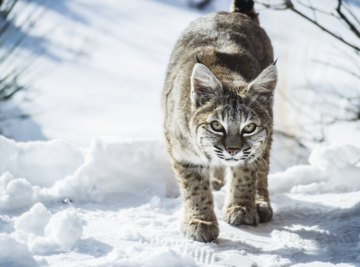

Bobcats are common wild animals found across the United States. They are often mistaken for other cats, such as mountain lions or house cats, but tend to be about twice as big as a domestic cat and smaller than a mountain lion. Left alone, they often pose no threat to humans, but in rare instances, bobcats can be dangerous.
TL;DR (Too Long; Didn't Read)
In rare cases, the dangers of bobcats for humans include being attacked or clawed. This is more common if the bobcat has rabies.
Living Near Humans
Despite their decreasing habitat, bobcat populations remain steady, in part because of their reclusive nature. They are common in mountainous suburban areas across the United States, and it is legal to hunt them in many states. Typically, they can live near human populations without incident.
Contact With People
Bobcats tend to be shy and avoid people. Rarely, a bobcat can become aggressive, and bobcats with rabies can attack humans. Bobcats with rabies tend to have erratic behavior, be lethargic and foam at the mouth. Anyone who sees a bobcat behaving strangely should contact the local animal control department. Bobcats can also attack if threatened or if cubs are nearby. The animals are fast and have sharp claws.
Contact With Pets
Although most bobcats tend to avoid humans, they can prey on unattended pets, birds, small livestock, rabbits and rodents. Keep small pets inside, and keep domestic birds in enclosed cages.
How to Discourage Bobcats
Bobcats are wild animals, so you should view them from a safe distance. In areas frequented by bobcats, make plenty of noise using bells. Clear bushes and other potential hiding places near your home. Do not keep pet food outside, as it can attract animals.
What to Do if Sighted
Although they are common in many areas, it is rare to actually see a bobcat. Do not set out food for bobcats, as they can become too accustomed to humans and less shy. Bobcats that are unafraid of humans must sometimes get euthanized by animal control departments. It is very rare for a bobcat to be aggressive, but if one does bite, it is important to immediately seek medical attention, as the animal could be rabid.
Know the Predator
Most attacks on small livestock and pets are by coyotes or free-ranging dogs, rather than bobcats. To tell the difference, look at the footprints. Bobcat footprints will not have toenail marks, as coyotes' and dogs' do. The rear heel pad of bobcat prints are typically in the shape of an "m." Bobcats also often bury their prey and return several times to feed on it, while coyotes do not. In addition, mountain lions (cougars) can kill livestock and pets. Mountain lion footprints look similar to those of bobcats but are much larger.
References
About the Author
Emily Potter has written professionally since 1998. She has edited local magazines, such as "Family Living in Southeast Idaho," and worked as a reporter for the "Idaho State Journal." Potter has a Bachelor of Arts in journalism from the University of Montana.