How to Spot Fluid on the Lung Symptoms
Fluid on the lung symptoms can be caused by many different difficulties. The most common is some form of pneumonia, but it can also be caused by lung cancer or most rarely, mesothelioma. As a result, it is wise to pay careful attention to fluid on the lung symptoms and get checked out by a physician quickly.
If you are experiencing serious medical symptoms, seek emergency treatment immediately.
Listen for raspy or rattled breathing.
Especially if the rasp or rattle seems to be deep within the chest this can be a sign of fluid on a lung. It may also, of course, be higher up and associated with the bronchial tubes. A physician will be able to determine where it is located.
Non-Hodgkins Lymphoma Cough Symptoms
Learn More
Pay attention to a persistent cough.
Do not write off a persistent cough as mere allergies or something you have to deal with. A persistent cough, either productive or unproductive, could be a sign of fluid on the lung. This could be an early indicator of lung cancer or other serious diseases and needs a full diagnosis.
Look for fever, aches, and fatigue.
These flu like symptoms can also present themselves when a patient has fluid on the lung. When they do, it often means that the patient has viral pneumonia, or is fighting an infection in the bronchial tubes and/or lungs. If the fever rises over 102 seek medical attention immediately.
What Is Basilar Consolidation?
Learn More
Notice and report shortness of breath.
For some patients the primary symptom of water on the lung is simply shortness of breath. Fluid can gather around the lungs due to congestive heart failure, lung cancer, or viral or bacterial infection. When this happens shortness of breath can occur.
- See more tips on identifying fluid on the lung symptoms (pneumonia, lung cancer) below.
Tips
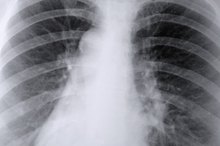
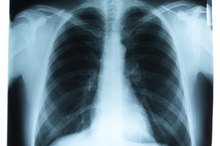
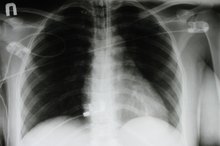
Often an x-ray or a EKG will be ordered to test and see exactly what cavity the fluid is inhabiting. This will also help rule out any chance of advanced lung cancer. Get plenty of rest and avoid exposure to cold air while dealing with water on the lung. Drinking plenty of clear fluids is usually helpful for most causes of fluid on the lungs. Check with your physician to be sure. See related articles on this page for more health information and diagnosis assistance.
Related Articles

Non-Hodgkins Lymphoma Cough Symptoms
Learn More
What Is Basilar Consolidation?
Learn More
Allergies and Lung Crackle While Exercising
Learn More

Heavy Breathing During Exercise
Learn More
Pancreatic Cancer & Fluid Buildup in the Lungs
Learn More

How to Get Rid of Throat & Nasal Mucus
Learn More
What Are the Causes of Infiltration of Lungs?
Learn More
What Causes Wheezing in the Chest?
Learn More

My Chest Hurts When I Breathe While Running
Learn More

Signs & Symptoms of Relapse From Pneumonia
Learn More
References
- Molassiotis A, Smith JA, Mazzone P, Blackhall F, Irwin RS. Symptomatic Treatment of Cough Among Adult Patients With Lung Cancer: CHEST Guideline and Expert Panel Report. Chest. 2017;151(4):861-874. doi:10.1016/j.chest.2016.12.028
- Myers DJ, Wallen JM. Cancer, Lung Adenocarcinoma. StatPearls Publishing. Updated January 11, 2019.
- Yao D, Zhang L, Wu PL, et al. Clinical and misdiagnosed analysis of primary pulmonary lymphoma: a retrospective study. BMC Cancer. 2018;18(1):281. doi:10.1186/s12885-018-4184-1
- Bradley S, Bradley S, Abraham S, et al. Sensitivity of chest X-ray for lung cancer: systematic review. British Journal of General Practice. 2018;68(suppl 1):bjgp18X696905. doi:10.3399/bjgp18x696905
- Walter FM, Rubin G, Bankhead C, et al. Symptoms and other factors associated with time to diagnosis and stage of lung cancer: a prospective cohort study. Br J Cancer. 2015;112 Suppl 1:S6-13. doi:10.1038/bjc.2015.30
- Stenqvist C, Majed A. [Shoulder pain as the first sign of disseminated lung cancer]. Ugeskr Laeg. 2013;175(5):287-8.
- NHS.UK. NHS Choices. Symptoms - Lung cancer. Updated August 15, 2019.
- Crisp CA, Pierce AN. Back pain and leg complaints that revealed non-small cell carcinoma: a case study. J Chiropr Med. 2011;10(3):185-8. doi:10.1016/j.jcm.2010.10.006
- Morel H, Raynard B, D'arlhac M, et al. Prediagnosis weight loss, a stronger factor than BMI, to predict survival in patients with lung cancer. Lung Cancer. 2018;126:55-63. doi:10.1016/j.lungcan.2018.07.005
- Oner AO, Boz A, Surer budak E, Kaplan kurt GH. Left Vocal Cord Paralysis Detected by PET/CT in a Case of Lung Cancer. Case Rep Oncol Med. 2015;2015:617294. doi:10.1155/2015/617294
- Carnio S, Di stefano RF, Novello S. Fatigue in lung cancer patients: symptom burden and management of challenges. Lung Cancer (Auckl). 2016;7:73-82. doi:10.2147/LCTT.S85334
- Kanaji N, Watanabe N, Kita N, et al. Paraneoplastic syndromes associated with lung cancer. World J Clin Oncol. 2014;5(3):197-223. doi:10.5306/wjco.v5.i3.197
- Donker GA, Wiersma E, Van der hoek L, Heins M. Determinants of general practitioner's cancer-related gut feelings-a prospective cohort study. BMJ Open. 2016;6(9):e012511. doi:10.1136/bmjopen-2016-012511
- Xing PY, Zhu YX, Wang L, et al. What are the clinical symptoms and physical signs for non-small cell lung cancer before diagnosis is made? A nation-wide multicenter 10-year retrospective study in China. Cancer Med. 2019;8(8):4055-4069. doi:10.1002/cam4.2256
- Rajagopal A, Simala J. Superior Vena Cava Syndrome Developing in Non-small Cell Lung Cancer. Chest. 2014;145(3). doi:10.1378/chest.1723701
- Riihimäki M, Hemminki A, Fallah M, et al. Metastatic sites and survival in lung cancer. Lung Cancer. 2014;86(1):78-84. doi:10.1016/j.lungcan.2014.07.020
- Corrales-rodriguez L, Blais N. Lung cancer associated venous thromboembolic disease: a comprehensive review. Lung Cancer. 2012;75(1):1-8. doi:10.1016/j.lungcan.2011.07.004
- Mccarthy WJ, Meza R, Jeon J, Moolgavkar SH. Chapter 6: Lung cancer in never smokers: epidemiology and risk prediction models. Risk Anal. 2012;32 Suppl 1:S69-84. doi:10.1111/j.1539-6924.2012.01768.x
- Smith CF, Whitaker KL, Winstanley K, Wardle J. Smokers are less likely than non-smokers to seek help for a lung cancer 'alarm' symptom. Thorax. 2016;71(7):659-61. doi:10.1136/thoraxjnl-2015-208063
- Malhotra J, Malvezzi M, Negri E, La vecchia C, Boffetta P. Risk factors for lung cancer worldwide. Eur Respir J. 2016;48(3):889-902. doi:10.1183/13993003.00359-2016
- American Cancer Society. Cancer Facts and Figures 2019. Atlanta: American Cancer Society; 2019.
- Centers for Disease Control and Prevention. Symptoms of Lung Cancer.
- Friedemann Smith C, Whitaker K, Winstanley K, and Wardle J. Smokers are Less Likely Than Non-Smokers to Seek Help for a Lung Cancer ‘Alarm’ Symptom. Thorax. Published online 21 Feb 2016. doi:thoraxjnl-2015-208063
Tips
- Often an x-ray or a EKG will be ordered to test and see exactly what cavity the fluid is inhabiting. This will also help rule out any chance of advanced lung cancer.
- Get plenty of rest and avoid exposure to cold air while dealing with water on the lung.
- Drinking plenty of clear fluids is usually helpful for most causes of fluid on the lungs. Check with your physician to be sure.
- See related articles on this page for more health information and diagnosis assistance.
Writer Bio
This article was written by the CareerTrend team, copy edited and fact checked through a multi-point auditing system, in efforts to ensure our readers only receive the best information. To submit your questions or ideas, or to simply learn more about CareerTrend, contact us [here](http://careertrend.com/about-us).