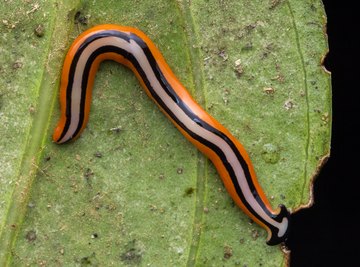

All organisms go through a life cycle that describes how they change from their origin to their ultimate end. Although the great majority of multicellular animals originate in the fertilization of an egg by sperm, there are some exceptions, and the planarians are examples of this.
Although new individuals can, and generally do, originate from fertilization, these flatworms can also originate asexually by binary fission. Most planarians have simple life cycles.
Defining Planaria
By definition, planaria actually refers to many species of flatworm under the class of flatworms called "Turbellaria". Other flatworms closely related to planaria include dugesia and marine polycladids. They are mostly aquatic living in both marine and freshwater environments.
They move around with cilia that are found covering the outside of their bodies. While they don't have true "eyes", many species of planaria have what are called "eye spots" where there are clusters of photoreceptors that can sense light.
As we said earlier, planarian reproduction can happen either by planarian regeneration or by traditional reproduction. Here are the details of both:
Planarian Reproduction by Fission
In this mode of planarian reproduction, the planaria simply constricts its body until it actually separates into two parts, one the anterior and the other the posterior ends. Each of the parts then regenerates the missing portion through binary fission and thus two complete individuals arise. Binary fission is common in many types of simple organisms like bacteria.
This mode of reproduction is rare, but it has been shown that it increases in frequency when the number of individuals in the area is low, possibly due to the difficulty in finding partners.
Planarian regeneration is not restricted to reproduction, either. When a planaria is cut into pieces, each piece is able to regenerate into a fully formed and functional individual organism. This process is extremely rare for animals, so it is extensively studied by scientists all over the world.
Sexual Planarian Reproduction
Although planarians are hermaphroditic, they normally do not self-fertilize. This means that although an individual carries both ovaries and testes, it does not use its own sperm to fertilize its eggs. When mating, planarians exchange sperm and each individual is fertilized by the other.
This mode of reproduction is the more common one and has the advantage of increasing the genetic variability of the species.
Egg Development
In some planarians, the yolk used to feed the embryo is not contained within female gamete but in specialized cells, called yolk cells, which are enclosed within the egg shell.
Others follow the more traditional pattern in which the yolk is contained in the female gamete. Eggs are laid on the underside of rocks or vegetation, attached to the substrate by a short stalk.
Planaria Life Cycle: Post Hatching Development
In most planarians, the embryo emerges as a juvenile that resembles the adult but does not have functional gonads, which develop later. I
n some cases, especially in marine forms, embryos hatch as free swimming larvae that are very different from the adult and must undergo metamorphosis.
Life Style
Planarians are free living, carnivorous animals. This is in stark contrast with their closest relatives, tapeworms and flukes, which are parasitic. Planarians live in the sea, in fresh water and even on land, but in the latter case in very humid environments, away from sunlight.
They can be as small as less than 5 mm or as big as 50 cm. They are flat and have very rudimentary sensory organs and digestive systems. They do have the three layers of tissues (endo, meso, and ectoderms), but they are solid and don't have an internal body cavity.
References
About the Author
Joao Ubeda is a freelance writer who also has a full-time job as a scientist in the life sciences. He holds a Ph.D in physiology from the University of Sao Paulo (Brazil) and started writing for Demand Studios in June of 2009, and his articles have appeared in eHow.