What does fact checked mean?
At Healthfully, we strive to deliver objective content that is accurate and up-to-date. Our team periodically reviews articles in order to ensure content quality. The sources cited below consist of evidence from peer-reviewed journals, prominent medical organizations, academic associations, and government data.
The information contained on this site is for informational purposes only, and should not be used as a substitute for the advice of a professional health care provider. Please check with the appropriate physician regarding health questions and concerns. Although we strive to deliver accurate and up-to-date information, no guarantee to that effect is made.
How to Read the SYS DIA Pulse
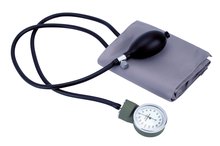
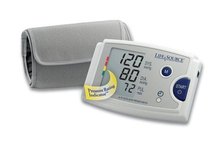
Personal blood pressure monitors allow you to check your blood pressure at any given time. When you use one of these monitors to check your blood pressure, the monitor displays two numbers. One of these numbers measures your systolic pressure, which is the pressure in the arteries when the heart beats, and one measures your diastolic pressure, which is the pressure in the arteries in between beats. If you want to read your systolic or diastolic pressure, you can do so by knowing what the various blood pressure levels mean.
If you are experiencing serious medical symptoms, seek emergency treatment immediately.
Locate the systolic pressure reading on the blood pressure monitor. This numbers is usually labeled as "SYS," and is the top-most reading on the blood pressure monitor.
What Is the Meaning of the Bottom Number on a Blood Pressure Reading?
Learn More
Determine where the systolic reading falls on the blood pressure scale. A normal systolic reading is below 120. A reading between 120 and 139 signifies prehypertension, a reading between 140 and 159 signifies Stage 1 hypertension, a reading of more that 160 signifies Stage 2 hypertension, and a reading of more than 180 signifies a hypertensive crisis. If your systolic pressure is over 180, you must seek emergency care immediately.
Locate the diastolic pressure reading on the blood pressure monitor 1. This numbers is usually labeled as "DIA," and is located directly below the systolic on the blood pressure monitor.
What Is the Formula for Calculating Blood Pressure?
Learn More
Determine where the diastolic reading falls on the blood pressure scale. A normal diastolic reading is below 80. A reading between 80 and 89 signifies prehypertension, a reading between 90 and 99 signifies Stage 1 hypertension, a reading of more that 100 signifies Stage 2 hypertension, and a reading of more than 110 signifies a hypertensive crisis. If your diastolic pressure is over 110, you must seek emergency care immediately.
Tips
Higher than normal and lower than normal blood pressure readings should be evaluated by your physician.
Related Articles
What Is the Meaning of the Bottom Number on a Blood Pressure Reading?
Learn More

What Is the Formula for Calculating Blood Pressure?
Learn More

How Do Automatic Blood Pressure Monitors Work?
Learn More
What If Blood Pressure Numbers Are Too Close?
Learn More

How To Take Your Blood Pressure with Sleeves
Learn More

How to Measure Blood Pressure Using a Sphygmomanometer
Learn More
How to Calibrate a Blood Pressure Monitor
Learn More

How to Calibrate a Blood Glucose Monitor
Learn More
How to Reset the Memory on a OneTouch Ultra2
Learn More
Instructions for Weight Watchers Scales
Learn More
References
- American Heart Association: Understanding Blood Pressure Readings
- Bavishi C, Goel S, Messerli FH. Isolated systolic hypertension: An update after SPRINT. Am J Med. 2016;129(12):1251-1258. doi:10.1016/j.amjmed.2016.08.032
- Yano Y, Stamler J, Garside DB, et al. Isolated systolic hypertension in young and middle-aged adults and 31-year risk for cardiovascular mortality: the Chicago Heart Association Detection Project in Industry study. J Am Coll Cardiol. 2015;65(4):327–335. doi:10.1016/j.jacc.2014.10.060
- Tan JL, Thakur K. Systolic Hypertension. StatPearls Publishing. Updated May 14, 2019.
- Ovbiagele B, Diener HC, Yusuf S, et al. Level of systolic blood pressure within the normal range and risk of recurrent stroke. JAMA. 2011;306(19):2137-44. doi:10.1001/jama.2011.1650
- Sheps SG. Isolated Systolic Hypertension: A Health Concern? Mayo Clinic. Published April 19, 2017.
Tips
- Higher than normal and lower than normal blood pressure readings should be evaluated by your physician.
Writer Bio
Alexander Poirier began writing professionally in 2005. He worked as the editor-in-chief of the literary magazine "Calliope," garnering the magazine two APEX Awards for excellence in publication. Poirer graduated from the University of the Pacific with a Bachelor of Arts in English.