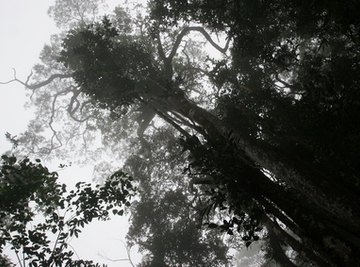
Known for its biodiversity, Malaysia is home to 15,000 flowering plants. However, the nation’s flora and fauna are under severe threat and have experienced a 70 percent depletion of original growth. According to the International Union for the Conservation of Nature’s (IUCN) Red List, Malaysia has 686 endangered plant species as of 2007. Malaysian laws protect birds, mammals and insects. Flora and fauna are only protected if they grow within a national park or reserve.
Giam Kanching (Hopea subalata)
The main forest types in Malaysia are Giam Kanching or rare dipterocarp forest, mangrove forest, peat swamp forest, and montane ericaceous forest, according to the Worldwide Wildlife Fund. The dipterocarp tree, known for its fruit with two-winged seeds, grows on land that is just above sea level to an altitude of approximately 900 meters. Lowland dipterocarp forests, which are found up to 300 meters above sea level, have been decimated due to agriculture and other land-intensive activities. While a pocket of dipterocarp trees are protected in the Kanching Forest Reserve, this species is considered critically endangered—on the verge of extinction—on the Red List.
Pitcher Plant (Nepenthes Macrophylla)
This carnivorous tropical plant grows only in mossy forests at a 2,000 to 2,600 meter altitude on Mount Trus Madi in Borneo. The Nepenthes macrophylla has pitcher-shaped leaves that dangle from ten meter-long vines. Insects slide from the waxy top of the flower into a pool of acid secreted by glands in the lower part of the flower, according to the ASEAN Review of Biodiversity & Environmental Conservation. The IUCN’s Red List has categorized the Nepenthes macrophylla as critically endangered.
Moss (Taxitheliella richardsii)
Considered critically endangered on Red List, Taxitheliella richardsii is a moss in the Sematophyllaceae family and native to Malaysia. The only known area (less than 10 km²) where the moss has been found is in Sarawak, a Malaysian state on northwest Borneo. Taxitheliella richardsii grows on woody vines and rotted logs in subtropical forests, a habitat that is disappearing due to wood harvesting and logging.
References
Resources
About the Author
Kay Tang is a journalist who has been writing since 1990. She previously covered developments in theater for the "Dramatists Guild Quarterly." Tang graduated with a Bachelor of Arts in economics and political science from Yale University and completed a Master of Professional Studies in interactive telecommunications at New York University.
Photo Credits
forêt primaire de bornéo image by Jj from Fotolia.com