
Newton's Law of Motion Games
In his "Philosophiæ Naturalis Principia Mathematica," published in 1687, English scientist Isaac Newton laid the groundwork for most of classical mechanics. Included in this work are a law of gravitation and his three laws of motion. These last three laws are also known as the law of inertia, the law of acceleration and the law of interaction. Various games can be used to demonstrate Newton's laws of motion to young science students.
-
Newton's Laws of Motion
-
Newton's three laws of motion can be stated quite succinctly.
First law: Masses in motion stay in motion; masses at rest stay at rest. This is the law of inertia.
Second law: The change of momentum on a body is proportional to the force applied to it. This is the law of acceleration.
Third law: For each action, there is an equal and opposite reaction. This is the law of interaction.
At the Ice Skating Rink
-
If you have access to an ice rink, play a game in which two skaters push each other away. The object of the game, which demonstrates the second and third laws simultaneously, is to see who can push away the farthest.
The two skaters are to start motionless, in contact, facing each other. They then push against each other, perhaps having started hand-to-hand to avoid surprising shoves that could cause a fall.
The skaters then coast to see who goes the farthest. Some skaters are able to accelerate backward, so a judge may have to watch skate motion to make sure neither competitor cheats this way.
If no accelerating is done by the skaters, the lighter skater should always win. This is because the same force is being applied on each, just in opposite direction, by the third law. By the second law, the change in momentum is equal but opposite. Since momentum is the product of velocity and mass, the lighter skater will acquire a greater speed.
The farthest-is-winner rule is preferable to a shortest-is-winner rule, since most skaters can brake going backward and may be tempted to cheat. -
Objects in Motion Resist Efforts to Stop It
-
Each team drops a tennis ball on carbon paper over blank paper from a short measured distance up. The distance should be short enough to make only a small mark, but not so short that the students can't catch the ball after one bounce, to leave only one mark. Measure the width of the mark left.
The challenge then is to throw the tennis ball at the carbon paper (from any distance above the paper) instead of passively letting it drop a specified distance. The aim is to make a second mark on a new sheet of paper that is as large as possible. The winning team has the largest mark.
This demonstrates the first law, because the ball resists the floor's effort to stop it, and spreads, showing that the center of mass continues even after the initial contact with the floor.
This demonstration also addresses a misconception among some students that a projectile's velocity upon landing is zero.
Rocket Propulsion
-
A seated child, kicking his legs out, will cause the chair to move backward. This demonstrates the third law, as well as the reason that rockets can propel themselves in space where there is nothing to push against.
This can be turned into a game in a couple of ways. The child who can propel her chair the farthest in one kick is the winner. Or a distance can be measured (say, a yard or two) and students can race.
To save space, and to demonstrate the second law, two students can back their chairs against each other to see who can kick the other a certain (short) distance. The competition of this last game may scare away many students, reducing the time demand for several match-ups. Padding may be needed to protect the chairs. The second law is demonstrated in that it is harder to accelerate more massive objects. Students can be asked, based on the second law, to predict who will win, and to discuss how the friction between the chairs and floor could prevent heavier students from moving.
In all cases, students will have to be refereed to ensure that they don't push off the floor.
The Third Law and Marbles
-
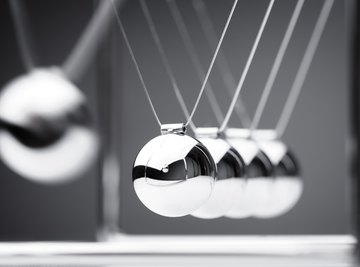
The third law can be demonstrated by the symmetry of incoming and outgoing marbles directed between a track made by two rulers. This is basically Newton's cradle done without pendulums.
One marble sent along the groove in the track hits two marbles dead-on. The first one comes to a stop and the third is released with the same energy.
The object of the game is to see which team can send in and out the greatest number of marbles that stay together, by controlling the packing of the marbles and the focus of the aim.
That the symmetric result is also the only solution to the conservation of momentum and energy laws need not be broached except in an advanced class.
-