Developed as a natural defense against microbes and browsing animals, saponins are bitter-tasting, toxic chemical compounds found in numerous plant species. Known for their distinctive foaming quality, saponins were an early source of detergents and soaps for cultures around the world. Although toxic to humans in large doses, saponins are sometimes used in traditional medicine for their purported antioxidant qualities.
Horse Chestnut
Video of the Day
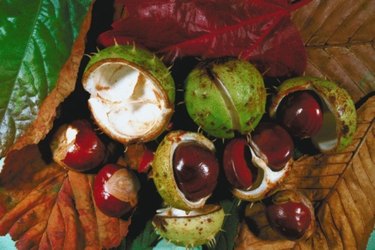
Native to the Balkans region of southeast Europe, horse chestnut (Aesculus hippocastanum) is an ornamental tree used around the world. Growing to 120 feet in height, it bears light-green, hand-shaped leaves comprised of five to seven ovate leaflets. Following a brief blooming period during which it produces 7 inch long upright flower stalks, horse chestnut is laden with a crop of reddish-brown nuts encased in a spiny chartreuse outer hull. The nuts, although attractive, are toxic when ingested due to their high concentration of alkaloid saponins. It is from the saponin-rich nuts, or conkers, that escin is extracted, which is a substance used in medicine to alleviate inflammation and swelling.
Video of the Day
Mojave Yucca
Known for its sword-like leaves and showy flower stalk, Mojave yucca (Yucca schidigera) thrives across the southwestern United States in the Mojave and Sonoran Desert. Utilized by the indigenous people of the region for centuries, Mojave yucca stores an abundance of saponin-rich fiber within its rhizomes, which was commonly harvested to produce a soapy substance used as a hair wash. Growing to 15 feet in height, Mojave yucca is a formidable plant to harvest due to its stiff and sharp leaves, which are colloquially referred to as "Spanish daggers."
Soapbark Tree
Named for its high concentration of foaming saponins, soapbark tree (Quillaja saponaria) has served as a source of detergent and medicine for the people of Andean Chile for hundreds of years. It is found at moderate altitudes between 5,500 and 7,000 feet, where it forms dense thickets in the forest understory. Growing to 50 feet in height, soapbark tree produces thick, blackish-brown bark from which its saponins are extracted. Once the outer layer of bark is removed, the inner layer is collected and pounded into a powder, at which point it is used to create soap, medicinal teas and compresses, insecticidal spray and food additives.
Soybean
One of the most common sources of nutritional saponins, soybeans (Glycine max) are cultivated around the world as a food crop and for industrial processing. Numerous cultivars exist, each varying in size and growth habit, although all bear hairy pods containing between two and four waxy, light-green beans. The beans are eaten whole or used in the production of food products such as tofu and soy sauce. As a source of industrially important saponins, soy beans are extensively processed to remove their hydrophilic ("water-loving") and hydrophobic ("water-repelling") chemical properties, which are then used as foaming agents and emulsifiers in many commercially produced soaps.
Wild Yam
Long used in traditional medicine, wild yam (Dioscorea villosa) has garnered interest from the mainstream medical community due to its high concentration of steroidal saponins and diosgenin, a type of phytoestrogen used in the production of oral contraceptives. It is native to the United States and was an important traditional remedy for both indigenous people and the early colonists, who harvested the large, well-developed tubers to treat colic, gynecological maladies and asthma. Easily identifiable, wild yam is a climbing vine covered in large, heart-shaped leaves.