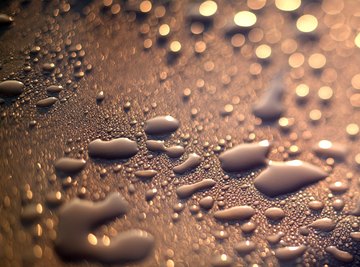

Liquid evaporating from a surface has a cooling effect. And different liquids have this effect to different degrees. For example, rubbing alcohol has more of an evaporative cooling effect than water. Alcohol evaporates comparatively more quickly than water, so scientists class it as a "volatile" liquid. But regardless of the liquid, they all follow the same principle of evaporative cooling. In its liquid state, the substance—whether water or alcohol—has a certain heat content, which is central to the process. Also critical to this are two of the three basic phases of matter: liquid and vapor. (The solid phase is, of course, the third.)
TL;DR (Too Long; Didn't Read)
TL;DR
Evaporation causes cooling because the process requires heat energy. The energy is taken away by the molecules when they convert from liquid into gas, and this causes cooling on the original surface.
Heat and Evaporation
When a liquid evaporates, its molecules convert from the liquid phase to the vapor phase and escape from the surface. Heat drives this process. In order for the molecule to leave the liquid surface and escape as a vapor, it must take heat energy with it. The heat that it takes with it comes from the surface from which it evaporated. Since the molecule is taking heat with it as it’s leaving, this has a cooling effect on the surface left behind. This makes it easy to understand evaporative cooling.
Evaporation and Human Perspiration
An example of evaporated cooling is that of human perspiration. We have pores in our skin from which liquid water internal to our skin is escaping and converting to water vapor in the air. As this happens, it cools down our skin surface. This happens almost constantly to one degree or another. When we are exposed to an environment that is hotter than what is comfortable for us, the degree of perspiration or evaporation increases. And it follows that the cooling effect increases. The more water molecules that are escaping from the liquid phase from our skin surface and from our pores, the more cooling effect there is. Again, this is because the liquid molecules, as they escape and become vapor, require heat and they take it with them.
Evaporation and Plant Transpiration
Plants do something similar, through a process called transpiration. Plant roots "drink" water from the soil and transport it up through the stem to the leaves. Plant leaves have structures called stomata. These are essentially pores that you can think of as comparable to the pores in our skin.
Function of Transpiration
One of the main functions of this process in plants is to transport water needed by plant tissues in other parts of the plant besides the roots. But this evaporative cooling effect also benefits the plant. This keeps the plant—which might very well be exposed to direct, intense sunlight—from overheating. And this also explains why, on a hot day, if we enter a forested area, we feel considerably cooler. Part of that is due to the shade, but part is also due to the evaporative cooling effect from the trees through this process of transpiration.
Wind Increases Evaporation
Wind increases the effect of evaporative cooling, and this is a familiar concept. Anyone who's ever been swimming and has come out of the water into a calm environment, versus one that's windy, can attest to it feeling colder in the wind. The wind increases the evaporation rate of the liquid water from our skin surface and accelerates the amount that's being converted to vapor.
Wind-Chill Factor
Incidentally, this process also causes so-called wind chill. Even in colder conditions, when we're outside and our skin is exposed to the elements, a certain amount of perspiration occurs. When it's windy, more evaporative cooling takes place from exposed skin. This explains the basics behind the so-called wind-chill factor.
References
About the Author
Donald Miller has a background in natural history, environmental work and conservation. His writing credits include feature articles in major national print magazines and newspapers, including "American Forests" and a nature column for "Boys' Life Magazine." Miller holds a Bachelor of Science in natural resources conservation.
Photo Credits
Thinkstock Images/Comstock/Getty Images