
Eight Traditional Sword Fighting Styles for a Samurai
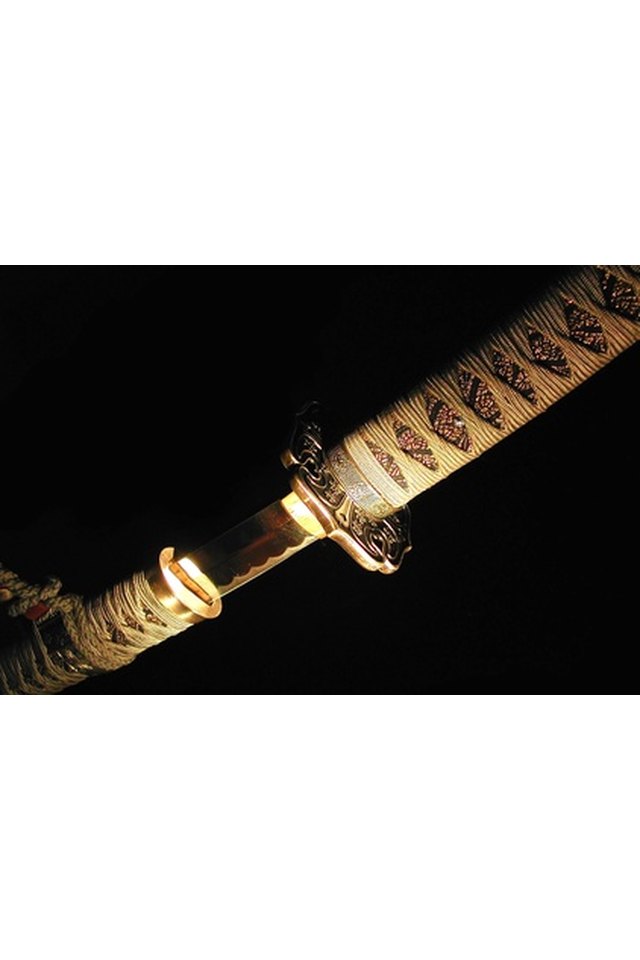
The samurai, Japan's elite warrior class, distinguished themselves from the rest of the population by wearing two swords, the katana and the wakizashi. These swords were more than just decoration--samurai created hundreds of fighting styles using them, and only the most effective styles survived through tests of combat.
Muso Jikiden Eishin-ryu
Muso Jikiden Eishin-ryu focuses on iaido. Iaido, derived from iaijutsu, develops the samurai skill of drawing the sword and cutting in the same movement, rather than cutting from a traditional stance after already having drawn the sword. Iaido aims to cultivate spiritual harmony in addition to the battlefield skill of iaijutsu. Eishin-ryu contains sitting techniques, standing techniques and techniques for use against multiple opponents, as well as for use on terrain.
Hyoho Niten Ichi-ryu
Although the samurai carried both a katana and a wakizashi, they only used the katana outdoors and the wakizashi indoors. Miyamoto Musashi, the famous samurai who wrote "The Book of Five Rings", developed Hyoho Niten Ichi-ryu. This style's name translates to "Two Heavens, One School" and refers to the trademark stance of both swords held above the head to attack. The swords work in a sequential rhythm; as one sword defends, the other attacks in the next step.
Tenshin Shoden Katori Shinto-ryu
Tenshin Shoden Katori Shinto-ryu remains the oldest surviving school of Japanese swordsmanship. According to Koryu, an index of traditional Japanese martial arts, Katori Shinto-ryu dates to 1447 and has had 20 headmasters based in Japan. The style encompasses training in the use of the katana, the bo staff, the halberd-like naginata, the spear and in empty-hand combat through jujitsu. Katori Shinto-ryu headmasters enjoy the status of Living National Treasures of Japan.
Mugai-ryu
The Chicago Mugai-ryu Study Group manual explains that this style has existed since 1691. It has both kenjutsu and iaijutsu techniques. Students train with bokken--wooden swords--or iaito, aluminum training swords with a dulled edge. Advanced students move on to tameshigiri exercises, which involve cutting targets to ensure proper form and blade angle during a cut. Mugai-ryu's iaijutsu curriculum incorporates two-person forms to help students achieve a sense of distance.
Ono-ha Itto-ryu
Ono-ha Itto-ryu's name translates to "one sword." The underlying principles of the style, and the branches of Itto-ryu that followed it, rely on a single powerful cut to defeat the enemy. According to Fighting Arts, Ono-ha Itto-ryu curriculum has over 150 techniques, many of which involve a direct downward cut through the center line of the body, often using the wrists as a target during their raised position when ready to attack. Modern kendo, the sport form of kenjutsu, derives its underlying philosophy from Itto-ryu.
Yagyu Shinkage-ryu
Yagyu Shinkage-ryu was the first style of the Tokugawa shogunate, before they began using Ono-ha Itto-ryu. Shinkage-ryu emphasizes flowing, subtle movements, and uses a longer and thinner blade. It contains some principles of aikido: instead of killing an enemy, the style encourages the use of disarming techniques.
Jigen-ryu
Jigen-ryu was founded in the late sixteenth century. It emphasizes a powerful first strike, intended to kill an enemy instantly. Students of Jigen-ryu stand in a modified Hasso-no-kamae stance, with the sword held vertically on the right side of the face with the guard at cheek level. The attacker makes a running hidari-kesa cut from the opponent's left shoulder to his right hip, cutting into the base of the neck where armor would not protect easily. You can learn Jigen-ryu in Kagoshima prefecture today.
Tamiya-ryu
Tamiya-ryu, founded in the late 1560s, makes use of a sword with a slightly longer hilt. A longer hilt gives the sword greater stability and power. When you stand in the high stance, Jodan-no-kamae, your opponent will have a tendency to look at the raised sword blade, and they will not notice foot movement. Tamiya-ryu requires large, precise movements.
Writer Bio
Michael Smathers studies history at the University of West Georgia. He has written freelance online for three years, and has been a Demand Studios writer since April 2009. Michael has written content on health, fitness, the physical sciences and martial arts. He has also written product reviews and help articles for video games on BrightHub, and martial arts-related articles on Associated Content.