This Season
 

About Crustaceans

About Crustaceansthumbnail
About Crustaceans

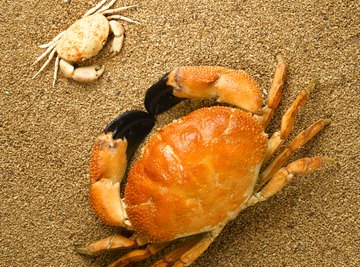
Crustaceans are arthropods, animals that have an external skeleton (an exoskeleton) jointed appendages to get around on and segmented bodies. Arachnids (spiders) and insects are are also arthropods. Just as insects are ubiquitous on land, crustaceans have successfully populated the waters. Some crustaceans have also adapted to living on land.

Related Searches:
    1. Examples

      • In the sea, crustaceans include shrimp, krill, crab and lobster. Barnacles, too, are crustaceans. Freshwater examples of crustaceans include water fleas and types of crayfish. Land crustaceans include woodlice and the coconut crab, also known as a robber crab. Crustaceans range in size from the microscopic--like the water flea--to the large crustaceans such as the giant spider crab, with a leg span of up to 4 meters--over 13 feet--and the meter-long coconut crab, which is the largest land crustacean.

      Anatomy

      • Crustaceans are invertebrates with appendages that are usually biramous, meaning they have two branches. The digestive tract is a tube that often has a grinder in it, with glands that then absorb the food. Crustaceans have antennae; at some point in their lives, they possess two sets. Within the head near the antennae are kidney-like structures. Ganglia, which serve as crustacean brains, are near the antennae as well. There are ganglia beneath the gut, too. Crustaceans have a head, thorax and abdomen, the thorax being the part that has the appendages serving as legs. The telson is at the end of the crustacean, analogous to a tail.

      Life Cycle

      • Most kinds of crustaceans have both male and female members, though some crustaceans are hermaphroditic. Hermaphroditic animals have both male and female reproductive organs. Crustaceans hatch from fertilized eggs. All crustaceans begin as a larval form known as a nauplius, which only has a head and telson. A nauplius only has one eye that later divides into two. The appendages nauplii use to swim later become antennae and mandibles. Once crustaceans have passed from the larval stage, their exoskeletons don't grow with the animal. For a crustacean to get larger, it molts (sheds) its exoskeleton. Crustaceans have different life spans. Some lobsters can live up to 100 years.

      Life as a Crustacean

      • There is great variety of lifestyles crustaceans possess. Most crustaceans swim (or walk) freely. Some are parasites. like crustacean lice, and latch themselves onto hosts. An example of a parasitic crustacean is the tongue worm, which lives in the respiratory tract of air-breathing animals. Others crustaceans don't move at all. After reaching adulthood, barnacles live permanently affixed to surfaces like ships. Crustaceans can communicate with one another. Lobsters urinate to communicate. Shrimp communicate by opening and closing their pincers, making underwater noise.

      Habitat Ranges

      • The marine crustaceans that we know are those accessible to us and these kinds number in the tens of thousands. Since crustaceans have adapted to so many different kind of habitats, many more species have yet to be discovered in places humans have yet to explore. Some marine crustaceans are part of plankton drift, floating together and providing food to a variety of creatures. Others live on the ocean floor. Though crustaceans primarily live in water, some survive in desert conditions. Some live in forests, under leaves on the forest floor. The coconut crab climbs trees. There have been crustaceans found high in the Andes mountains. Krill live in the cold water of Earth's poles, feeding whales and many other animals, which, in turn, provide food to humans.

    Related Searches

    References

    Resources

    • Photo Credit Belin Czechowicz

    Read Next:

    Comments

    You May Also Like

    • Types of Crustaceans

      With up to 42,000 species, crustaceans live across the world in both fresh and salt water. Crustaceans fall into five classes: branchiopods,...

    • Interesting Facts About Crustaceans

      Crustaceans are sea animals that have an armored exoskeleton, including crabs, lobsters and shrimp. Many crustaceans are a source of food.

    • Crustaceans Facts

      Crustaceans are a very successful group of arthropods, a class of organisms that also includes insects and spiders. Although most crustaceans are...

    • Crustacean Facts

      Comments. You May Also Like. Crustaceans Facts. Crustaceans are a very successful group of arthropods, a class of organisms that also includes...

    • Crustaceans of Florida

      Marine species of arthropods, which can be found in the waters of Florida, are classified as a type of crustacean. These animals...

    • Characteristics of Crustaceans

      Characteristics of Crustaceans. With estimates ranging from 30,000 to 70,000 known species, crustaceans represent a large contingency of the planet's invertebrates and...

    • What Do River Otters Eat?

      There are several kinds of river otters, including the North American, Southern, Eurasian and Neotropical river otters. While fish is their main...

    • What Is the Meaning of Crustacean?

      Crustaceans are among the largest groups of animals on the planet. These common marine creatures, called arthropods, make up about 50,000 species...

    • Crustaceans Definition

      Crustaceans are a class of marine invertebrates that have exoskeletons, antennae, chewing mouthparts and three or more pairs of legs. Lobsters, crabs,...

    • The Classifications of Crustaceans

      The Classifications of Crustaceans. Crustaceans are a type of arthropod, which is a class of creatures that all have hard exoskeletons, bilateral...

    • Guide to Aquatic Insects & Crustaceans

      The phylum Arthropoda includes both insects and crustaceans. Crustaceans such as crabs and shrimp are strictly aquatic, whereas insects may be found...

    • List of Florida Crustaceans

      Florida is home to thousands of miles of shore land and is aptly named the Sunshine State. It is replete with a...

    • Differences Between Crustaceans & Insects

      Along with arachnids, crustaceans and insects belong to the same group---arthropods. Sharing distinctive physical characteristics, such as absence of backbone, hard ...

    • The Characteristics of Crustaceans & Mollusks

      There are over 30,000 species of crustaceans and over 100,000 species of mollusks. Animals in the crustacean family include crabs, crayfish, shrimp,...

    • How to Keep Live Lobsters

      Lobsters spoil quickly, so lobster sellers must ship them live and store them in saltwater tanks. Once you've purchased live lobsters, you...

    • Blue Lobster Life Cycle

      Blue lobsters possess a rare genetic mutation involving an excessive amount of protein that causes their shells to turn cobalt blue. Their...

    • Different Kinds of Shells

      Different Kinds of Shells. There are many animals that have shells. Some animals have soft shells, but others have rock-hard ones. The...

    • How to Identify Crustaceans

      Lobsters, crayfish, crabs, prawns, shrimp and barnacles are a few animals that can be described as crustacean. There are over 42,000 varieties...

    Follow eHow

    Related Ads