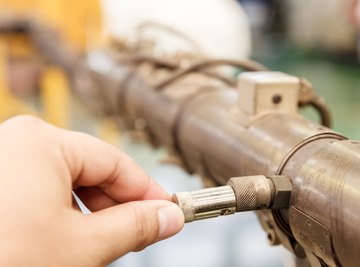
Thermocouples are one of the most commonly used forms of temperature measurement. They are very rugged and durable and are highly accurate. However, even they can fail. Thermocouples rely on voltage that metals at different temperatures produce. The proportion of the voltage generated by this reaction is directly proportional to the temperature difference of each metal.
Wear and Tear
Engineers make thermocouples with metals. They are subjected to wear and tear and will eventually fail. The breakdown of the thermocouple is not obvious, and those who use it do not always realize that the metal is breaking down until the sensor suddenly fails. With some applications, sudden thermocouple failure can lead to an expensive breakdown. As thermocouples become thinner, they tend to produce inaccurate temperature readings, usually readings that are lower than what the temperature really is. When at operating temperature, changing thermocouples is dangerous and challenging.
Impurities
If the thermocouple gets any impurities inside during its manufacture or installation, the deterioration of the thermocouple will occur more rapidly. Fortunately, thermocouple exposure to the atmosphere causes oxidation on the surface, which reduces the currents carried across the sectional area.
Seebeck Voltage Reduction
Thermocouple failure often begins with a reduction in Seebeck voltage, which occurs over the course of several weeks and is not easy to notice. The Seebeck voltage is the direct conversion of temperature differences to electrical voltage. If the Seebeck voltage is low, the measured temperature will be low, too. The actual process temperature will rise to create the necessary Seebeck voltage. This could create too much temperature generation, damaging the material and disrupting the process.
Poor Welding
When welders create the metal for the thermocouple, a poor weld can cause an open connection. An open thermocouple check – which is the breaking of the hot junction of the thermocouple -- can detect this open connection. Since this form of failure is easy to detect, it is unfortunate that this mode of failure is uncommon uniformity.
Recalibration
Recalibration is a kind of thermocouple failure that occurs when the chemical nature of one of the wires changes, leading to a thermocouple reading that seems correct. The calibration can come from atmospheric particles entering the metal, usually caused by extremes in temperature. Besides high temperature, rough handling can also strain the thermocouple wire, leading to the recalibration uniformity.
Overheating
The welding process can ruin the thermocouple if carried out incorrectly. Overheating the thermocouple with the welding tools can degrade the wire. In addition, the gas and atmosphere near the wire can enter the thermocouple metal, changing its characteristics. Because of this, expensive equipment produces thermocouples in a way that ensures uniformity.
References
About the Author
Chuck Robert specializes in nutrition, marketing, nonprofit organizations and travel. He has been writing since 2007, serving as a ghostwriter and contributing to online publications. Robert holds a Master of Arts with a dual specialization in literature and composition from Purdue University.