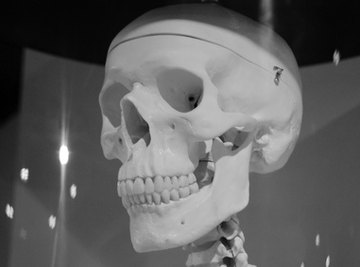

The human skull is a complex structure housing the brain. An adult skull consists of 22 bones; the jaw bone (mandible) is the only bone in the skull that moves. The rest of the bones of the skull are firmly interlocked creating a solid skeletal shell.
Structure
The 22 bones of the human skull are divided into cranial bones and facial bones. There are eight cranial bones which protect the brain and sensory organs. The facial area consists of a framework of 14 facial bones; the teeth are supported in this structure. The bones of the skull and face develop in such a way that various cavities are formed. The cranial cavity is the largest cavity of the skull and houses the brain. The nasal cavity is segregated by the nasal septum which is both bone and cartilage. The organs for hearing and balance are located within the cranial cavity, labeled the inner ear; these tiny bones vibrate, creating the sense of hearing. The mouth is only partially formed by bone; its structure also includes muscle, tissue, cartilage and glands. The eyeballs are held in place by the interlocking facial and cranial bones.
Fetal Development
During the development of the fetus, the skull is developed with fibers linking the cranial bones. A year after birth these fibers disappear and the cranial bones fuse together. The pliability of the cranial bones in the fetus allow it to travel through the birth canal safely. Gaps between developing skull bones are common during the initial stages of development. These gaps are covered by protective tissue membranes.
Child Development
The pliable head which allowed the child to safely pass through the birth canal is also responsible for enabling normal human development during the first 18 months of a child’s life. During this period the brain grows rapidly and the skull has to be flexible enough to adapt to its growth. The natural development of the cranial and facial bones involves changes in skull shape, which is also accommodated by the lack of a permanently fused skull. The permanent skull is fused between the ages of 20 months and two years.
Names of Skull Bones
The eight bones of the cranium are the occipital, two parietal, frontal, two temporal, spheroid and ethmoid bones. The 14 bones of the face, which surround the cavities of the mouth and nose and complete the cavities for the eyes, are the two nasal, two superior maxillary, two lachrymal, two zygomatic (malar), two palate, two inferior turbinated, vomer and inferior maxillary.
Abnormalities in Development
The bones of the skull change dramatically throughout a child’s development. Any abnormalities in this process of change can result in a disorder, producing head or facial abnormalities. Such abnormalities can affect physical appearance, vision, brain function and breathing.