What does fact checked mean?
At Healthfully, we strive to deliver objective content that is accurate and up-to-date. Our team periodically reviews articles in order to ensure content quality. The sources cited below consist of evidence from peer-reviewed journals, prominent medical organizations, academic associations, and government data.
- MayoClinic.com: Liver Problems
- "Forschende Komplementarmedizin"; An Updated Systematic Review with Meta-Analysis for the Clinical Evidence of Silymarin; R. Saller, et al.; February 2006
- "Forschende Komplementarmedizin"; An Updated Systematic Review with Meta-Analysis for the Clinical Evidence of Silymarin; R. Saller, et al.; February 2006
- "Medizinische Klinik"; A Conservative Triple Antioxidant Approach to the Treatment of Hepatitis C. Combination of Alpha Lipoic Acid (Thioctic Acid), Silymarin and Selenium: Three Case Histories; B. Berkson; October 1999
- "Medizinische Klinik"; A Conservative Triple Antioxidant Approach to the Treatment of Hepatitis C. Combination of Alpha Lipoic Acid (Thioctic Acid), Silymarin and Selenium: Three Case Histories; B. Berkson; October 1999
The information contained on this site is for informational purposes only, and should not be used as a substitute for the advice of a professional health care provider. Please check with the appropriate physician regarding health questions and concerns. Although we strive to deliver accurate and up-to-date information, no guarantee to that effect is made.
Can You Take Alpha Lipoic Acid & Milk Thistle at the Same Time?
Your liver carries out essential functions that help to keep you healthy, including producing and storing energy, making blood proteins, manufacturing some hormones, helping digest fats and cleaning your blood of toxins and drugs. If your liver becomes injured or diseased, this may cause serious, potentially life-threatening illness. Milk thistle and alpha-lipoic acid are two natural remedies that help support liver function and may be beneficial when taken together. Talk to your doctor to decide whether one or both might be appropriate for you.
If you are experiencing serious medical symptoms, seek emergency treatment immediately.
Milk Thistle
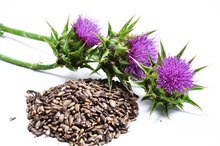
The milk thistle plant, or Silybum marianum, has been part of traditional herbal medicine for thousands of years. It contains a group of natural flavonoids, collectively called silymarin, that is largely responsible for its medicinal properties. Silymarin stabilizes membranes of liver cells, excluding toxins and other potentially harmful agents from the cells. It also boosts protein synthesis by liver cells, helping them multiply to replace damaged or dying cells and supporting liver regeneration. Silymarin also helps to clear toxins from the liver by preventing their recirculation through the organ. A substantial amount of laboratory and clinical research supports the positive effects of silymarin on the liver, including a comprehensive review published in the German journal "Forschende Komplementarmedizin" in 2006 that concluded that milk thistle is a useful treatment for treating and reversing liver damage 3.
- The milk thistle plant, or Silybum marianum, has been part of traditional herbal medicine for thousands of years.
- Silymarin stabilizes membranes of liver cells, excluding toxins and other potentially harmful agents from the cells.
Alpha-Lipoic Acid
Herbal Treatment for Liver Cirrhosis
Learn More
Alpha-lipoic acid is a natural compound found in some foods, including red meat, organ meats and yeast. Your body also manufactures alpha-lipoic acid as needed and uses it to help convert glucose in your blood into energy. Alpha-lipoic acid is also a powerful antioxidant that removes free radicals from your body. Free radicals are metabolic byproducts or environmental toxins that might harm your cells by damaging membranes, DNA or other components. Unlike most other antioxidants, alpha-lipoic acid is able to dissolve in both water and fats, making it able to affect all parts of your body.
- Alpha-lipoic acid is a natural compound found in some foods, including red meat, organ meats and yeast.
- Your body also manufactures alpha-lipoic acid as needed and uses it to help convert glucose in your blood into energy.
Actions
Alpha-lipoic acid has a number of beneficial actions in your body. It lowers blood sugar, helping you to reduce your risk for diabetes or improve your health if you are diabetic. Because it can pass into the brain, it may also protect you from stroke-related brain damage and other neurological problems. Its antioxidant activity may also protect your organs, including your liver, from cellular damage caused by toxins and other harmful compounds, and it may increase your resistance to DNA damage that can cause cancer.
- Alpha-lipoic acid has a number of beneficial actions in your body.
- Because it can pass into the brain, it may also protect you from stroke-related brain damage and other neurological problems.
Combination Therapy
Herbs for Liver & Spleen Support
Learn More
Milk thistle and alpha lipoic acid appear to use different mechanisms to protect your liver and other organs from damage and may therefore be beneficial when taken together. In a German clinical study published in "Medizinische Klinik" in 1999, silymarin, alpha-lipoic acid and selenium were combined to treat hepatitis in three human subjects 5. The results were very positive, leading the authors to suggest that this combination therapy is a good therapeutic approach.
Milk thistle and alpha-lipoic acid are available as supplements from health food stores. Both are considered generally safe, although alpha-lipoic acid may lower blood sugar and interact with diabetes medicines, and milk thistle may interfere with several prescription medications. Discuss both supplements in detail with your doctor before adding one or both to your regimen.
- Milk thistle and alpha lipoic acid appear to use different mechanisms to protect your liver and other organs from damage and may therefore be beneficial when taken together.
Related Articles
Herbal Treatment for Liver Cirrhosis
Learn More

Herbs for Liver & Spleen Support
Learn More

Herbs for Liver Cysts
Learn More

Natural Herbs for the Gallbladder
Learn More

How Does Turmeric Damage Or Benefit the Liver?
Learn More
Lemongrass & Cancer
Learn More

What Are the Benefits of Water on Liver Detoxification?
Learn More
The Health Benefits of Andrographis
Learn More
Vitamins and Supplements for Cirrhosis
Learn More
Does Cranberry Juice Help to Detox the Liver?
Learn More
References
- MayoClinic.com: Liver Problems
- University of Maryland Medical Center: Milk Thistle
- "Forschende Komplementarmedizin"; An Updated Systematic Review with Meta-Analysis for the Clinical Evidence of Silymarin; R. Saller, et al.; February 2006
- University of Maryland Medical Center: Alpha-Lipoic Acid
- "Medizinische Klinik"; A Conservative Triple Antioxidant Approach to the Treatment of Hepatitis C. Combination of Alpha Lipoic Acid (Thioctic Acid), Silymarin and Selenium: Three Case Histories; B. Berkson; October 1999
- Memorial Sloan-Kettering Cancer Center: Alpha-Lipoic Acid
- Memorial Sloan-Kettering Cancer Center: Milk Thistle
- Gomes MB, Negrato CA. Alpha-lipoic acid as a pleiotropic compound with potential therapeutic use in diabetes and other chronic diseases. Diabetol Metab Syndr. 2014;6(1):80. doi:10.1186/1758-5996-6-80
- Akbari M, Ostadmohammadi V, Lankarani KB, et al. The effects of alpha-lipoic acid supplementation on glucose control and lipid profiles among patients with metabolic diseases: A systematic review and meta-analysis of randomized controlled trials. Metab Clin Exp. 2018;87:56-69. doi:10.1016/j.metabol.2018.07.002
- Zhang Y, Han P, Wu N, et al. Amelioration of lipid abnormalities by α-lipoic acid through antioxidative and anti-inflammatory effects. Obesity (Silver Spring). 2011;19(8):1647-53. doi:10.1038/oby.2011.121
- Mijnhout GS, Kollen BJ, Alkhalaf A, Kleefstra N, Bilo HJ. Alpha lipoic acid for symptomatic peripheral neuropathy in patients with diabetes: a meta-analysis of randomized controlled trials. Int J Endocrinol. 2012;2012:456279. doi:10.1155/2012/456279
- Kucukgoncu S, Zhou E, Lucas KB, Tek C. Alpha-lipoic acid (ALA) as a supplementation for weight loss: results from a meta-analysis of randomized controlled trials. Obes Rev. 2017;18(5):594-601. doi:10.1111/obr.12528
- Koh EH, Lee WJ, Lee SA, et al. Effects of alpha-lipoic Acid on body weight in obese subjects. Am J Med. 2011;124(1):85.e1-8. doi:10.1016/j.amjmed.2010.08.005
- Pagano C, Calarco P, et. al. Development and characterization of new topical hydrogels based on alpha lipoic acid—hydrotalcite hybrids. Cosmetics 2019;6(2), doi:10.3390/cosmetics6020035
- Tolunay O, Çelik T, Kömür M, Gezgin AE, Kaya MS, Çelik Ü. A rare cause of status epilepticus; alpha lipoic acid intoxication, case report and review of the literature. Eur J Paediatr Neurol. 2015;19(6):730-2. doi:10.1016/j.ejpn.2015.07.002
- Bao Y, Gao C, Hao W, et al. Effects of dietary L-carnosine and alpha-lipoic acid on growth oerformance, blood thyroid hormones and lipid profiles in finishing pigs. Asian-Australas J Anim Sci. 2015;28(10):1465-70. doi:10.5713/ajas.14.0604
- Han T, Bai J, Liu W, Hu Y. A systematic review and meta-analysis of α-lipoic acid in the treatment of diabetic peripheral neuropathy. Eur J Endocrinol. 2012;167(4):465-71. doi:10.1530/EJE-12-0555
Writer Bio
Joanne Marie began writing professionally in 1981. Her work has appeared in health, medical and scientific publications such as Endocrinology and Journal of Cell Biology. She has also published in hobbyist offerings such as The Hobstarand The Bagpiper. Marie is a certified master gardener and has a Ph.D. in anatomy from Temple University School of Medicine.