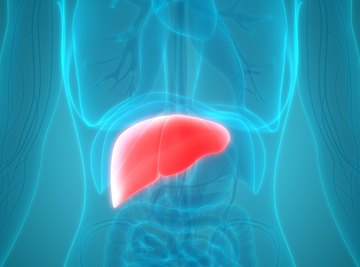
The liver is a large, roughly cone-shaped organ that rests in the upper abdomen. Weighing about 3 pounds and reddish-brown in color, the liver serves a variety of critical metabolic functions, acting as a factory, warehouse and gatekeeper, among other responsibilities.
The liver's size and extensive vascularization (i.e., its blood-vessel network), combined with its operating largely as a filtration organ, make the liver susceptible to a range of diseases and problems, including physical contusions, infections, poisoning and forms of cancer. That the liver does everything it does for your body, for as long as it typically does in the face of these challenges, is a testament to its remarkable biological evolution.
How Many Livers Are in the Human Body?
Perhaps because of the liver's size and the fact that many vital organs (e.g., eyes, lungs, kidneys, gonads) come in pairs, the everyday citizen may not know that everyone has but a single liver. Also, the liver is divided into two lobes, each of which is made up of eight segments containing about 1,000 small lobules each. That means the liver in the human body refers to approximately 16,000 distinct lobules. If you do a little more math, you can conclude based on the liver's total size of roughly 3 pounds, or 48 ounces, that each lobule has a mass of about 48/16,000 of an ounce, or 0.003 ounces. That's a little less than a tenth of a gram – not microscopic, but getting there. The two lobes are separated by a band of fibrous tissue, rather like very tough and sticky plastic wrap, that also anchors the liver to the abdominal cavity itself.
The liver's anatomy includes a number of distinct features, such as portal triads (also called hepatic triads) and specialized liver cells called hepatocytes. As is unfailingly the case in the world of life science, form is intertwined with function, and the unique arrangement of and elements within liver cells are compelled by the unique jobs the liver does around the clock. These features are described in detail in a subsequent section.
What System Is the Liver In?
Although functional divisions of living systems may be somewhat arbitrary, the liver is considered a part of the gastrointestinal, or GI, system. While no food products pass through the liver itself, substances produced in the liver are absolutely vital for the digestion of food. In particular, the liver manufactures bile, which is essential for the digestion and absorption of fats. (Fats are one of three kinds of macronutrients in the diet, the others being proteins and carbohydrates.) The 800 to 1,000 milliliters of bile produced in liver cells every day – that's about 2 pounds of the stuff, mind you – eventually makes its way into the duodenum, the part of the GI tract below the stomach but above the small intestine proper. The bile helps break down the long-chain fatty acids in fats (which are also called triglycerides; triglycerides all contain three fatty acids each) to prepare them for absorption into the bloodstream across the small intestinal wall.
Another way in which the liver contributes to gastrointestinal system functioning is by manufacturing cholesterol. You've probably heard of this substance because of its reputation of a dietary villain, something to be avoided in the diet owing to its contribution to cardiovascular disease. While the precise role of cholesterol in heart disease is continually being refined, it's clear that you need some amount of it, because your own body makes it – it doesn't just come from foods you eat. Cholesterol is a fat-protein structural hybrid molecule that transports fats throughout the bloodstream.
What Side Is Your Liver On?
The liver's location in general anatomic terms is usually given as the right upper quadrant (RUQ) of the abdomen. As noted, the liver is among the largest organs of the body, weighing about 3 pounds in adults. While found on the right-hand side of the body, its leftmost portion sits above the top of stomach, which is found mostly on the left-hand side of the body below the heart.
The liver is somewhat irregularly shaped; schematically, it resembles a cone with a rounded top and flat base. The top of the liver borders the diaphragm, the dome-shaped muscle that is responsible for drawing the lungs downward toward the abdomen; the diaphragm represents the anatomic border between the thorax and the abdomen.
At any moment, the liver contains about one-eighth of the blood in your body, about a pint. This is owed partly to the liver's sheer size, but it is mostly a reflection of the liver's function. Blood enters the liver from two main sources: the hepatic artery, which comes more or less straight from the heart and carries oxygenated blood to nourish the liver tissues in the usual way of the circulatory system, and the portal vein, which collects the blood bathing the intestines and routes it through the liver to give the organ a chance to process materials absorbed in the GI tract before they have a chance to reach the rest of the system. When blood leaves the liver, it enters the venous system and makes its way to the right side of the heart.
The liver is directly under and surrounded by your ribcage, making it available for a health provider to perform basic tests such as percussion (tapping) and palpation (feeling). When a health provider can feel the liver extending below the border of the lowermost ribs, however, this may be a sign of liver inflammation (hepatitis) or other liver disease. Often, RUQ pain is a sign of liver disease or inflammation of the gall bladder, found on the underside of the liver.
How Does the Liver Work?
The liver is probably the single most diverse organ in the body, with over 500 specific, distinctly identified functions. The liver converts the raw products of digestion into smaller molecules that can be used directly in cellular metabolic processes. It detoxifies the blood by ridding it of drugs and poisonous substances, including the ammonia that results from protein metabolism (the liver converts ammonia to urea, which can then be excreted in urine and sweat). It manufactures a variety of proteins, including the "factors" responsible for the blood-clotting cascade of chemical reactions. It contributes to immune-system function by removing bacteria from the blood directly and by making immune factors that fight off invading microbes. It serves as a storehouse of the important metal iron, which it extracts from hemoglobin in red blood cells. It clears the blood of bilirubin, also from red blood cells; an over-accumulation of bilirubin results in a condition called jaundice, which is often evident because of the yellowing of the sclera of the eyes of affected individuals. (This is why jaundice has long been recognized as a reliable sign of serious liver disease or outright liver failure.)
The liver is able to work in the way that it does, again, thanks to its very generous and dual blood supply, and the route that blood takes to reach the liver. The hepatic artery is like any other artery in that it carries oxygenated blood to the liver and nourishes its cells with oxygen and nutrients. The portal vein, meanwhile, enters the bottom of the liver alongside the hepatic artery but carries mostly deoxygenated blood from the stomach and intestines, along with whatever the blood passing through the lining of the stomach and intestines has absorbed. The hepatic triads, mentioned earlier, consist of very small branches of the hepatic artery and portal vein running parallel to small bile ducts and between the hepatocytes they serve. (A triad, more generally, is a group of three things.)
This structural arrangement has a number of implications for the administration of drugs, both therapeutic and recreational, via different routes. When someone swallows a drug, it is absorbed mostly by the small intestine and winds up passing through the liver before it can reach the rest of the body after being pumped through the heart. Within the liver, it may be deactivated, or it may be converted from an otherwise inactive substance into the active form of a medication. This is why some drugs are only effective when given intravenously; when injected, these drugs make it to the heart and then to the rest of the body before the liver has a chance to work on them. This is called the first-pass effect.
What Is the Function of the Liver?
A complete description of the liver's duties could fill a textbook. In an overview, it makes sense to focus chiefly on the liver's metabolic functions.
Glucose is the small molecule that ultimately serves as fuel for cells. It can be derived from all three macronutrients, but it is primarily associated with carbohydrate breakdown and assembly. Humans have to maintain blood glucose levels within a fairly narrow range – about 70 to 110 milligrams per deciliter (tenth of a liter) of blood plasma. The liver is the main contributor in the short and long term to the maintenance of steady glucose levels. The liver converts glucose to a storage form of the molecule called glycogen, which is really just a long chain of glucose molecules. When glucose is in high demand, such as during a marathon run, glycogen can be broken down in the liver and the resulting glucose carried to the leg muscles where it is needed. When an oversupply of glucose exists, it can be stored, to a limited extent, as glucose. Finally, glucose itself can be made in the liver "from scratch" (actually, from amino acids and other small carbon-containing molecules).
The liver is also extremely active in fat metabolism. Triglycerides are broken down into glycerol and fatty acids in liver tissues, and the fatty acids themselves are either oxidized for use by the very busy and energy-demanding liver itself or shuttled to other tissues. As noted, the liver makes cholesterol and other lipoproteins, which are transport molecules for fats. When nutrients are ingested in excess of the body's needs, the liver converts the glucose and amino acids from carbohydrates and proteins, as well as ingested fats themselves, into triglycerides that are packaged and distributed to other parts of the body for storage as adipose tissue.
Finally, the liver's role in protein metabolism is similarly indispensable. Amino acids, the building blocks of proteins, contain a significant amount of nitrogen in the form of amino groups. These are removed in the liver from amino acids, freeing the acids for use in carbohydrate and far metabolic pathways. The liver also makes blood proteins such as albumin, amino acids that therefore do not need to be eaten in the diet. Finally, without the liver converting ammonia to urea, the ammonia that would otherwise build up would irreversibly poison the brain and other elements of the central nervous system.
It should be clear from the foregoing discussion that without the liver, life cannot continue for more than a day or two, which is why getting on liver-transplant lists is a literal do-or-die proposition for those unfortunate enough to suffer from serious liver disease (see the "Resources" for a list of common hepatic maladies).
References
About the Author
Kevin Beck holds a bachelor's degree in physics with minors in math and chemistry from the University of Vermont. Formerly with ScienceBlogs.com and the editor of "Run Strong," he has written for Runner's World, Men's Fitness, Competitor, and a variety of other publications. More about Kevin and links to his professional work can be found at www.kemibe.com.