
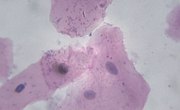
You need look no further than the human body to understand the makeup of eukaryotic cells, as all people have these cells within them. In biology, there are only two types of cells: eukaryotic and prokaryotic. In the taxonomical classification of all life, eukaryotic-celled life forms belong to the Eukarya domain, with Bacteria and Archaea being the other two domains.
The living organisms that fall under these latter domains consist of single-celled organisms. The Eukarya domain in the Linnaean classification system contains the kingdoms of protists, fungi, plants and animals. While there are some singled-celled protozoa in the eukarya domain, the majority of living organisms classified in this domain are multicellular entities.
TL;DR (Too Long; Didn't Read)
The striking difference between eukaryotic and prokaryotic cells, when comparing both cell types, is that eukaryotic cells have a distinctive nucleus with DNA bound together by proteins and contained within its own separate chamber inside the cell.
Eukaryotic Cell Origins
At this time, scientists posit that all life first began on the Earth about 3.5 or so billion years ago based on the fossil records of the first forms of life. It appears that prokaryotic cells evolved first as very small cells – about 1 or 2 micrometers in size (abbreviated as µm) – when compared with eukaryotic cells, which are generally about 10 µm or bigger. A µm represents one-millionth of a meter. Geological records show that eukaryotic cells first appeared about 2.1 billion years ago.
Last Common Universal Ancestor
Prolonged studies of cellular life forms led scientists to conclude that eukaryotic cells living today share a single common ancestor. But in July 2016, the "New York Times" reported that a group of evolutionary biologists, led by Dr. William F. Martin of the Heinrich Heine University in Dusseldorf, Germany, concluded that all life on the planet shares a single common ancestor: the last universal common ancestor, nicknamed LUCA.
Not without controversary, Dr. Martin and his group's theory indicates that the gene map they developed during the hunt for LUCA's origins points to a form of a bacteria, believed to have lived about 4 billion years ago, 560 million years after the creation of the Earth. While Darwin posited that life began in a warm, little pond, Martin's group found that the gene map pointed to a single-celled life form living in deep volcanic vents at the bottom of the ocean. This life form, they believe, gave rise to the Bacteria and Archaea domains, with the Eukarya domain emerging about 2 billion or so years ago.
Distinctive Eukaryotic Cell Characteristics
While both cell types share some common characteristics, eukaryotic cells are more complex. Distinctive characteristics that define eukaryotic cells include:
- All eukaryotic cells have a separately enclosed nucleus inside the cell's cytoplasm.
- Mitochondria exists in one form or another inside the eukaryotic cell's nucleus.
- All existing eukaryotic cells contain a cytoskeletal structure or elements.
- Eukaryotic cells utilize flagella and cilia to move around; there are some eukaryotes that don't have them, though their ancestors did.
- They have chromosomes within the nucleus, consisting of a single, linear DNA molecule spiraled around alkaline proteins named histones.
- Cell reproduction in eukaryotic cells occurs via mitosis, a process whereby the chromosomes divide by using components within the cytoskeleton.
- All eukaryotic cells have cell walls.
The Plasma Membrane of Eukaryotic Cells
All cells have a plasma membrane that separates the inside of the cell from its outside environment. The membrane contains embedded proteins and other components that allows the passage of ions, oxygen, water and organic molecules to move in and out of the cell. Waste byproducts such as carbon dioxide and ammonia – with help from protein "movers" – also pass through these cellular membranes. These membranes can take on unique shapes, like the microvilli found on the cells lining the small intestine, which increase the cell's surface area to absorb nutrients from food within the digestive tract.
Cytoplasm: Jelly-like Substance Inside the Cell
A view inside the cell shows a semi-liquid, jelly-like substance that reaches from the cellular membrane all the way to the enclosed nucleus. The organelles, various specialized structures within the cell, float in this gel consisting of cytosol, in the cytoskeleton and multiple chemicals. The cytoplasm is primarily 70 to 80 percent water, but in a gel-like form. The cytoplasm inside a eukaryotic cell also contains proteins and sugars, amino, nucleic and fatty acids, ions and a plethora of water-soluble molecules.
The Cytoskeleton in the Eukaryotic Cell
Inside the cytoplasm there is a cytoskeleton which consists of microfilaments, microtubules and intermediate fibers which help to maintain the cell's shape, provide an anchor to organelles and is responsible for cell movement. The elements that make up microtubules and microfilaments assemble as needed for cellular movement and reassemble when the cell's needs change.
The Cell's Nucleus
Many scientific words have origins in Latin or Greek, and eukaryotic cells are no exception. The cell's very name, broken down to its origins means "well or true nut," representative of the cell's nucleus. Eu in Greek stands for well or true, while the base word karyo means nut. Prokaryotic cells do not have an enclosed nucleus inside the cell, as the genetic material, though in the cell's center, exists within the cytoplasm of the cell.
The nucleus of the eukaryotic cell stores chromatin, consisting of DNA and proteins, in a gel-like substance called nucleoplasm. The nuclear envelope surrounding the nucleus consists of two layers; inner and outer permeable membranes that allow the passage of ions, molecules and RNA material between the nucleoplasm inside the nucleus, and the inside of the cell. The nucleus is also responsible for ribosome production. The nucleus of the eukaryotic cell's DNA material, chromosomes, provide a plan of sorts, for cell reproduction.
Cell Division and Replication
At a microscopic level, cells divide and replicate, a characteristic shared by both eukaryotic and prokaryotic cells to create new cells from old. But prokaryotic cells divide using binary fission, while eukaryotic cells divide by a process called mitosis. This does not include sexual reproduction among species, which occurs via meiosis, where a single egg and sperm combine to make an entirely new living being. Only non-reproductive cells divide by mitosis in the Eukarya domain.
Also known as somatic cells, non-reproductive cells make up most of the cells in the human body including its tissues and organs like the digestive tract, muscles, skin, lungs and hair cells. The reproductive cells – sperm and egg cells – within eukaryotic cells are not somatic cells. Mitosis involves multiple stages that define that cell's divisional status: prophase, prometaphase, metaphase, anaphase, telophase and cytokinesis. Prior to division, the cell rests in an interphase status.
Through a series of stages, the chromosome replicates itself, and each strand moves to opposite poles within the nucleus to allow the nucleus' envelope to converge and surround each chromosome. In animal cells, a cleavage furrow separates the diploids, or daughter cells, into two. In eukaryotic plant cells, a type of cell plate forms prior to the new cell wall that separates daughter cells. Upon division, each daughter cell is a genetic duplicate of the original cell.
Meiosis Cell Division of Eukaryotic Cells
Meiosis cell division is the process by which living organisms within the Eukarya domain create their sex cells like male sperm and female egg cells. The difference between mitosis and meiosis is that the genetic material inside diploid cells is the same, while in meiosis, each new cell contains a distinctive and unique blueprint of genetic information.
Once meiosis occurs, sperm and egg cells are available to create a whole new lifeform. This allows for genetic diversity among all living entities that reproduce sexually. During meiosis cell division, which occurs in basically two stages, meiosis I and meiosis II, a small portion of each chromosome breaks off and attaches itself to another chromosome called genetic recombination. This small step is responsible for genetic diversity among a species. Prior to meiosis I, the reproductive cell exists in interphase, in preparation for cell division.
Eukaryotic Cell Ribosomes Make Protein
Each part of a eukaryotic cell has an important role to play in maintaining the life of the cell. Ribosomes, for example, when viewed through an electron microscope, can appear in one of two ways: like a collection of grapes or as tiny dots floating within the cytoplasm of the cell. They can also attach to the inside wall of the plasma membrane or on the outer membrane of the nuclear envelope as either small or large subunits. Protein production is an essential purpose of all cells, and almost all cells contain ribosomes, especially in cells that produce a lot of protein. Cells in the pancreas, responsible for generating enzymes that aid digestion, contain many ribosomes.
The Endomembrane System
The endomembrane system is composed of the nuclear envelope, plasma membrane, Golgi apparatus, vesicles, endoplasmic reticulum and other structures derived from these elements. All play a part in the function of the cell, though some differ in their appearance and purpose. The endomembrane system moves proteins and membranes around the cell. For example, some of the proteins constructed on ribosomes are bound to the rough endoplasmic reticulum, a construction that resembles a maze that attaches to the exterior of the nucleus. These structures help to modify and move proteins, among other purposes, to where they're needed in the cell.
The Energy Factory of Eukaryotic Cells
All cells require energy to function, and the mitochondria is the energy plant of the cell. Mitochondria produce adenosine triphosphate, abbreviated as ATP, which is a molecule – the energy currency of all life – that carries energy within the cell for a short time. This mitochondrial structure in the cell resides in the cytoplasm between the outer membrane of the cell and the outer walls of the cell's nucleus. They contain their own ribosomes and DNA with a phospholipid bilayer infused with proteins.
Differences Between Eukaryotic Plant and Animal Cells
Plants and animals fall under the Eukarya domain because of the main characteristics of the eukaryotic cell, but differences exist between cells within the plant and animal kingdoms. While both plant and animal eukaryotic cells have microtubules, tiny tubes that help to segregate chromosomes during cell division, animal cells also have centrosomes and lysosomes present in the eukaryotic cell, while plants do not. Plant cells, in addition to having chloroplasts that assist in photosynthesis (turning the energy of the sun into food), for example, also have a large central vacuole, a space inside the cell containing primarily liquid and enclosed by a membrane.
Chloroplasts in Eukaryotic Plant Cells
Chloroplasts are the structures within eukaryotic plant cells that contain chlorophyll and enzymes that contribute to the photosynthesis process in which plants make food from water and carbon dioxide using the energy of the sun. These little factories are responsible for releasing oxygen as a product of photosynthesis back into the atmosphere.
These large structures of the plant cell contain DNA and a double membrane, as well as an internal membrane system made of thylakoids that appear like flattened sacs. The stroma is the space between the outer membrane and the thylakoid that contains chloroplast DNA, the "factory" that makes protein for the chloroplast, as well as other enzymes and proteins.
References
About the Author
As a journalist and editor for several years, Laurie Brenner has covered many topics in her writings, but science is one of her first loves. Her stint as Manager of the California State Mining and Mineral Museum in California's gold country served to deepen her interest in science which she now fulfills by writing for online science websites. Brenner is also a published sci-fi author. She graduated from San Diego's Coleman College in 1972.