
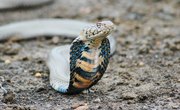
The king cobra is the largest of all poisonous terrestrial snakes. Just 1/5th of a fluid oz. of king cobra venom can kill an elephant, according to Animal Corner. The king cobra is shy by nature, although it will defend itself when it must. The king cobra exists in southeast Asia and feeds mostly upon other snakes, leading to its scientific name of Ophiophagus hannah--Ophiophagus is Latin for "snake-eater."
Size
The largest specimens of king cobra can be as long as 18.5 feet, although the typical king cobra is in the 12- to 15-foot range. Most king cobras will not exceed about 44 lbs. in weight. The hollow fangs the king cobra uses to inject its venom into its prey are about a half-inch long.
Geography
The king cobra lives in eastern and northeastern India, southeastern China, the Malay Peninsula Indonesia and the Philippines. The king cobra lives in habitats such as open woodlands, stands of bamboo, farmland and dense mangrove swamps. King cobras are good swimmers, and the snakes often live in close proximity to water, such as a pond, stream or river.
Defensive Posture
The king cobra, just like all cobra species, can flatten out its cervical ribs in its neck region, giving the snake the appearance of having a hood. The king cobra will do this when it perceives danger, and a pair of dark spots on the hood can fool a potential predator into thinking they are the cobra’s eyes, unnerving the would-be predator. The king cobra can bring the upper portion of its body--as much as a third of it--off the ground to confront a threat. The snake will hiss as it does this to ward off its foe. It will strike with its fangs as a last resort.
Function
The king cobra's venom is a neurotoxin that affects the nervous system and can shut down a victim's heart. Only the gaboon viper can inject more venom with its bite. The king cobra produces this venom out of polypeptides and proteins in special glands located behind the eyes. The venom flows through the fangs when the snake attacks, and it gets into the area of the bite, working rapidly to disable its prey.
Diet
Other snake species comprise the majority of the king cobra’s diet, but the king cobra will even eat its own kind. The king cobra will supplement its diet with small rodents such as rats and mice, as well as lizards. Because snakes cannot chew anything they eat, they rely on potent acids in the stomach to break down their prey so they can digest.
Breeding
Only the king cobra, among the other snakes of the world, builds a nest for its eggs, with the female using leaves and sticks for this purpose. After laying her eggs, the female guards them. The eggs require as many as 80 days to hatch. Baby cobras measure up to 20 inches long at birth and are able to fend for themselves immediately.
References
About the Author
John Lindell has written articles for "The Greyhound Review" and various other online publications. A Connecticut native, his work specializes in sports, fishing and nature. Lindell worked in greyhound racing for 25 years.
Photo Credits
Tom Brakefield/Stockbyte/Getty Images