What Is the Chunnel Train?

What Is the Chunnel Train? thumbnail
What Is the Chunnel Train?

Europe's Chunnel Train, also known as the Channel Tunnel and Eurostar, is an underwater rail service linking England and northern France. Constructed beneath the English Channel, the rail system has been named one of the Seven Wonders of the Modern World. Since opening in 1994, it has become a vital lifeline transporting both passengers and goods.

  1. History

    • Display of Tunnel Construction

      The design for the first English Channel tunnel was introduced in 1802 with numerous excavation attempts made in the following 150 years. It wasn't until 1973 that any real progress was made, but even this project was abandoned in 1975 due to a lack of funding. Finally in 1984, the British and French governments began looking for private investors to take on the feat. The Eurotunnel Group, comprised of 200 banks and commercial investors, presented organized plans and were granted the project contract in 1986, breaking ground in 1988. The train opened to passengers in 1994.

    Purpose

    • Chunnel Sign

      The original goal of the Channel Tunnel was to expedite transportation of people, commercial goods, vehicles, buses and equipment between London and Paris. Tourists can travel between the cities in 2 hours and 15 minutes, increasing tourism revenue for both cities. Additional destinations and connections have since been added, allowing travel between London and Brussels in 1 hour 50 minutes.

    Construction

    • Construction of the Chunnel

      More than 60,000 jobs were created during the six years it took to build the engineering marvel, but the project also faced many setbacks. Construction was plagued by worker fatalities, fires and equipment failure. At a cost of $5 million a day, the build was far overbudget, with the total cost quoted between $7 billion and $21 billion. A culmination of these issues led to a delay in the chunnel's opening.

    Tunnel Facts

    • The tunnel consists of three interconnected, 5-foot thick concrete tubes. Two of the tubes, each spanning 14 feet across, contain the railway tracks. The center tube is designated for emergency vehicles and maintenance crews. The tubes are buried an average of 150 feet below the sea bed, with some sections reaching a depth of 250 feet. The tunnel covers a total of 31 miles, 23 underwater.

    Train Facts

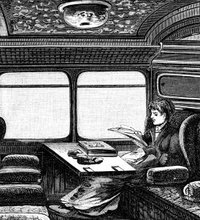
    • Inside the Chunnel Train

      The trains, or shuttles, reach 20 cars long and earned the distinction of being the longest passenger trains in the world. The speed of the train is dependent on the rail type. The UK has updated sections with high-speed rails, increasing the train's speed to 168 mph. Inside the tunnel the trains travel approximately 100 mph. Tracks in France and Belgium allow shuttles to reach 186 mph. Passengers can choose premium-, first- or standard-class tickets.

Related Searches:

Resources

  • Photo Credit Photos: Bitman, Marcin Wichary, Austinevan- Creative Commons Attribution License

Comments

You May Also Like

  • History of the Chunnel

    The Chunnel is the nickname for the "channel tunnel" running under the English Channel between Folkestone, England and Sangatte, France. Thanks to...

  • What Is a Chunnel?

    The tunnel built under the English Channel to connect London's Waterloo station and Paris's Gard du Nord is colloquially referred to as...

  • How to Ride the Chunnel from London to Paris

    With the advent of Eurostar's new High Speed 1, clocking in at just over 208 mph, getting to Paris from London has...

  • How to Take the Chunnel

    The Channel Tunnel, popularly known by the portmanteau "Chunnel," is a passage carved under the English Channel that connects the coasts of...

  • About the English Channel Tunnel

    The English Channel Tunnel, which is also known as the Chunnel, is a three tunnel railway that connects England and France.The journey...

  • Chunnel Tunnel Facts

    The Channel Tunnel between France and England, a true feat of man-made technology, took a long time to construct and overcame a...

  • Information About the Channel Tunnel

    Engineers tried to design ways to link England and France by land since the early 19th Century. They found success in the...

  • Chunnel Information

    Chunnel is the moniker used to refer to the English Channel underwater tunnel that connects England to France. Since its inception, the...

  • How to Swim the English Channel

    Swimming the 21-mile English Channel is considered the "Everest of open-water swimming." People who attempt to do this have to contend with...

  • How to Use Eurostar

    The Eurostar rail service links London to Paris through the "chunnel" (English Channel tunnel) and also goes from Paris to Brussels. It...

  • History of the Channel Tunnel

    The Channel Tunnel has been named one of the Seven Wonders of the Modern World by the American Society of Civil Engineers....

  • Channel Tunnel Travel Information

    Opened in 1994, the Channel Tunnel is an underground rail link between the United Kingdom and continental Europe. It takes its name...

  • Facts About the Eurostar Train

    Comments. You May Also Like. Information on Eurostar. Eurostar is a line of high-speed trains that run between London, Brussels and Paris,...

  • How to Make the Chunnel Mixed Drink

    The Chunnel is a mixed drink with gin that's easy to make at home. Our professional bartender will show you how.

  • What Is the Purpose of the FAFSA Application?

    A college education is a major step forward for a young person---and a major expense. Many students need at least some financial...

  • What Are Theater Spotlights?

    A theatre spotlight is any light with a lens that you can focus onto a particular part of a stage. There are...

  • How to Take the Chunnel Using the Eurail Pass

    The 31-mile-long Chunnel, or tunnel under the English channel, connects London to Brussels and Paris on the European continent. Using your Eurail...

  • How to Travel by Train in Europe Safely

    Traveling through Europe by train can be a thrilling experience. The trains run all over Europe and the cost is often cheaper...

Related Ads

Featured