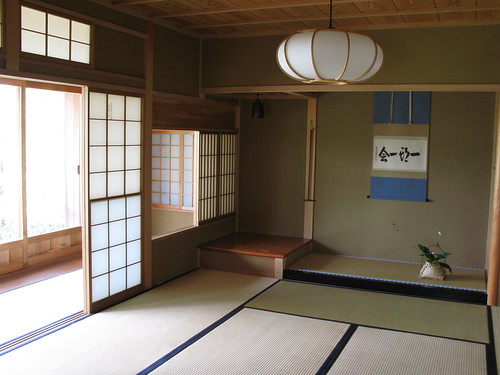
About Tatami

About Tatami thumbnail
About Tatami

Tatami, which originated in Japan, is becoming popular in the United States and other countries when it comes to interior design. Though outside of Japan tatami is used mainly as a decor item, it does have great cultural and historical significance. Does this Spark an idea?

  1. History

    • Tatami originated during the Heian period, and was first used as luxury seating mats for nobility. It also represented symbols of wealth, as few could afford it, and those who could not buy it resorted to sitting on dirt floors or straw. During the Muromachi period, tatami started being used to cover the floors of entire rooms, whereas it was formerly put to use only as seating mats. Such rooms were called zashiki, and rules concerning the use of them developed--some of the rules are still widely recognized today. At the end of the seventeenth century, tatami mats made their way into the homes of commoners.

    Regional Differences

    • In Japan, the size of tatami mats are determined by the region they are used in. There are Kyoma tatami (from Kyoto), Ainoma tatami (from Nagoya) and Edoma or Kantoma tatami (from Tokyo). Half-size tatami mats are referred to as hanjo. Quarter-length mats, which as used in tea ceremony rooms, are known as daimedatami.

    Layout Etiquette

    • During the Edo period, two types of tatami layouts developed--auspicious and inauspicious. In the auspicious layout, the tatami os arranged to form a T-shape. With inauspicious tatami layouts, the grid pattern forms a plus (+) shape. Today, the auspicious layout is most commonly used.

      When used in a home, tatami mats shouldn't be put in the inauspicious layout--it is thought to bring bad luck. Additionally, tatami shouldn't be put in a grid pattern, and there shouldn't be a point where the corners of three or four mats touch.

    Traditional Uses

    • In Japanese culture, tatami mats and flooring are kept very clean--as clean as a dining surface in many cases. Tatami are typically associated with the traditional Japanese tea ceremony and performance of religious rites. Most Japanese homes have at least one room with tatami in it.

      Other uses for tatami mats are in Japanese martial arts, such as judo and the practice of tameshigiri (Japanese swordsmanship).

    Modern Uses

    • Today, tatami is still used in Japanese homes, although not as widely as in the past. People commonly have just one room with tatami flooring or mats. These rooms are known as nihonma or washitsu.

      In countries outside of Japan, tatami is commonly used when one wants their decor to reflect a Japanese style. The traditional etiquette attached to tatami flooring is not typically regarded in other countries, as tatami is seen only as a decorative item. Now, tatami is also used to make furniture, such as beds and futons.

Related Searches:
  • Photo Credit www.tatamiroom.com

Comments

You May Also Like

  • Rules for a Tatami Layout

    Rules for a Tatami Layout. Tatami mats are traditional Japanese flooring materials, created from rice straw and woven, soft rush straw. The...

  • Size of Tatami Mats

    Size of Tatami Mats. In the 12th century, Japanese tatami mats were used as floor coverings by dignitaries, religious leaders and nobles....

  • What Is Tatami Made Of?

    Tatami mats are a straw matting used to cover the floors in traditional Japanese homes. Tatami mats today are still manufactured using...

  • What Is a Tatami Room?

    A Japanese tatami room, called a washitsu (or nihonma), is a room decorated in a traditional Japanese style. It has shoji and...

  • Tatami Room Etiquette

    In Japanese martial arts, proper etiquette holds as much, if not more, importance in the learning process because of the long historical...

  • How to Make Your Own Tatami

    Tatami are often used in martial arts training as a tool for practicing swordsmanship. Throughout Japanese history, tatami mats were made from...

  • What Is the Purpose of a Tatami Room?

    A tatami room is a fixture in washitsu, or traditional Japanese interior design. The tatami room, with its simple furnishings and open...

  • Traditional Japanese Tatami

    Tatami mats have served as the traditional covering for floors in Japanese homes since the 17th century, according to the tatami company...

  • How Big is a Tatami?

    A tatami mat is a traditional Japanese floor covering typically made out of a core of rice straw wrapped with a covering...

  • Tile Layout Patterns & Ideas

    Tile Layout Patterns & Ideas. Tile patterns and layout plans vary from the simplest grid design to complex alternating styles. Before considering...

  • Definition of a Tatami Mat

    A long-established type of Japanese floor covering, the tatami mat is primarily composed of rice straw. They resemble thick, cloth tiles that...

  • How to Break-In a Tatami Mat

    Tatami mats are a common floor covering found in Japan. The mats are made with a straw filling, a woven reed covering...

  • What Does Shoji Mean?

    Shoji is a Japanese word for traditional wood and paper screens. Still used in Japan today, the clean lines and soft light...

  • How to Buy Tatami Mats

    Tatami mats are woven straw and packed rice straw or styrofoam. All tatami mats have a uniform size and shape. Buying tatami...

  • Japanese Terminology in Competitive Judo

    What do judo terms mean? Learn about Japanese terminology in competitive judo in this free video clip on marital arts.

  • How to Make a Tatami Platform Bed

    A platform bed is simply a reinforced box upon which you can place either a mattress or tatami mats. This Asian style...

  • How to Build a Tatami Room

    A tatami room, or washitsu, is a traditional, Japanese-style room that has several standard elements. Years ago, all rooms in a Japanese...

  • What Cream Can You Put on a Burn to Help it Heal?

    There are many old-fashioned home remedies for burns, such as smearing butter or lard onto the damaged skin. But contrary to those...

Related Ads

Featured