
What Are the Trophy Names for Major Sports?
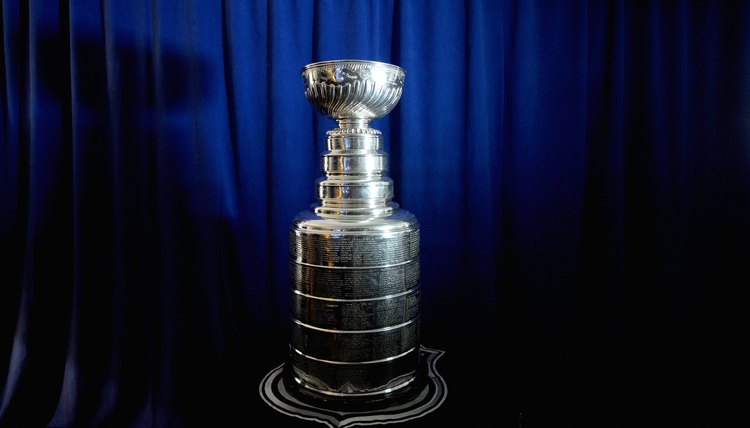
Major U.S. professional sports leagues have awards that become as legendary as the players who win them. Nothing says hockey greatness like skating around with the Stanley Cup, or baseball pitching domination like the Cy Young Award. Sports trophies can be named for former players, coaches, league officials -- or, in some cases, for whoever donated the hardware itself.
Football
The National Football League hands its Super Bowl champion the Vince Lombardi Trophy, named in honor of the legendary Green Bay Packers coach who led his team to victories in the first two editions of the game. Participants in the Big Game already have received trophies: The NFC champions earn the George Halas Trophy, named for the former Chicago Bears owner and one of the early pioneers of the game. The AFC champions get the Lamar Hunt Trophy, memorializing the principal founder of the American Football League that later merged with the NFL. One of the prestigious individual honors is the Walter Payton Man of the Year, which recognizes the star Chicago Bears player for his off-field work.
Baseball
The Major League Baseball World Series winner receives the Commissioner’s Trophy. As the name suggests, it’s handed out by the current MLB commissioner. The National League pennant winner gets the Warren C. Giles Trophy, while the American League champion earns the William Harridge Trophy. Both are named after former league presidents. The Most Valuable Player earns the Kenesaw Mountain Landis Memorial Baseball Award, named after the first baseball commissioner. Baseball’s best pitcher in each league earns the Cy Young Award, while the Hank Aaron Award was introduced in 1999 to honor each league’s best hitter. Top fielders at each position in each league earn Golden Glove awards, and the best hitters at each spot earn Silver Sluggers.
Basketball
National Basketball Association champions walk away with the Larry O’Brien Trophy, named after a former league commissioner. The MVP of the finals also gets the Bill Russell Trophy, named for the Boston Celtics Hall of Famer. The regular-season MVP, on the other hand, wins the Maurice Podoloff Trophy, honoring the first NBA president, while the top rookie wins the Eddie Gottlieb Trophy, named after the former NBA coach, general manager and owner. The Coach of the Year takes home the Red Auerbach Trophy, named for the legendary Boston Celtics coach and owner. In addition, the Sportsmanship Award is named after Joe Dumars, the former Detroit Pistons Hall of Famer.
Hockey
Unlike other sports, many hockey trophies are named after the donor of the award. One of the most recognizable trophies in sports, the Stanley Cup, is awarded to the champion of the National Hockey League. It's named after Lord Stanley of Preston, who originally awarded the trophy to Canada's top amateur club while serving as the Governor General of Canada. The Hart Memorial Trophy given to the Most Valuable Player is named after Dr. David Hart, who donated the trophy. The Lady Byng Trophy, awarded to the player who exhibits the best sportsmanship, was given to the league by Marie Evelyn Moreton -- the wife of Viscount Julian Byng, another former Canadian Governor General. The Art Ross Trophy goes to the league’s top scorer, and comes from former hockey player, coach and general manager Art Ross. The Veznia Trophy is an exception -- given to the league’s top goaltender, it honors ex-Montreal goalie George Veznia, whose career ended suddenly when he died of tuberculosis in 1926.