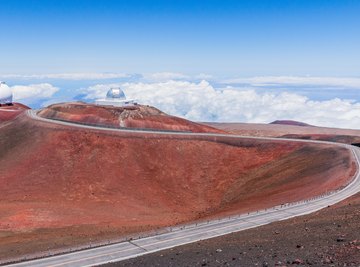
Mauna Loa, or Long Mountain, is a large volcanic mountain that helped form the main island of Hawaii in the Hawaiian Islands of the Pacific Ocean. The Mauna Loa volcano is one of five volcanoes that make up the island of Hawaii. As the largest volcano in the world, Mauna Loa is a wonder of nature. Here are some Mauna Loa facts and legends to consider.
Formation of Mauna Loa
You might think all volcanoes are cone-shaped mountains that erupt by exploding molten lava into the air. The Hawaiian volcanoes, including Mauna Loa, are different. The Hawaiian volcanoes are shield volcanoes that were formed by lava slowly spilling out from a crack or fissure in the earth’s crust. Because of this, shield volcanoes are wide with gently sloping sides, and their eruptions aren't violent. Scientists believe Mauna Loa began to form over a million years ago when red hot lava spilled out from a crack in the ocean floor. The lava cooled and formed a raised area on the bottom of the ocean. This process continued over thousands of years until a sea mount or underwater mountain was formed. Eventually, the mountain became tall enough to rise above the surface of the ocean and become an island.
Eruption History
Mauna Loa is one of the most active volcanoes in the world, meaning it erupts frequently. According to the Hawaiian Volcano Observatory, Mauna Loa has erupted 33 times since 1843. Mauna Loa's last eruption was in March of 1984. Volcanologists, scientists who study volcanoes, carefully watch Mauna Loa for signs of volcanic activity. They also study the mountain to determine what path the lava flow might follow so they can issue specific warnings in case of another eruption.
One Big Mountain
Mauna Loa is a long, wide mountain, shaped somewhat like a warrior’s shield. According to the Hawaii Center for Volcanology, Mauna Loa is 60 miles long, 30 miles wide and rises 13,680 feet above sea level. However, much of Mauna Loa’s true height is masked by the sea. Mauna Loa’s long, sloping flanks or sides descend to the ocean floor more than 16,000 feet below sea level. When measured from the ocean floor, Mauna Loa is actually more than 30,000 feet tall, making it slightly taller than Mt. Everest.
Hawaiian Legends
Legends are stories, not necessarily based on truth, that are handed down from one generation to another to explain certain events. According to Hawaiian legend, Mauna Loa was formed by the volcano goddess Pele when she was fleeing her jealous sister Na-maka-o-kaha'i. Pele made the mountain tall and large so her sister could not send ocean waves to put out the fires of Pele’s volcano. One story says that when a Hawaiian volcano is about to erupt, Pele sends a white dog from her home on Mauna Loa to warn villagers below.
References
About the Author
Based in the Atlanta area, Charlene Williams has been writing and editing since 1988. She has over 15 years of experience working as a technical writer in the software industry. She has worked as a freelance writer for the past five years, and is a contributing writer for eHow and Answerbag. Williams holds a Bachelor of Arts in English from Kennesaw State University.