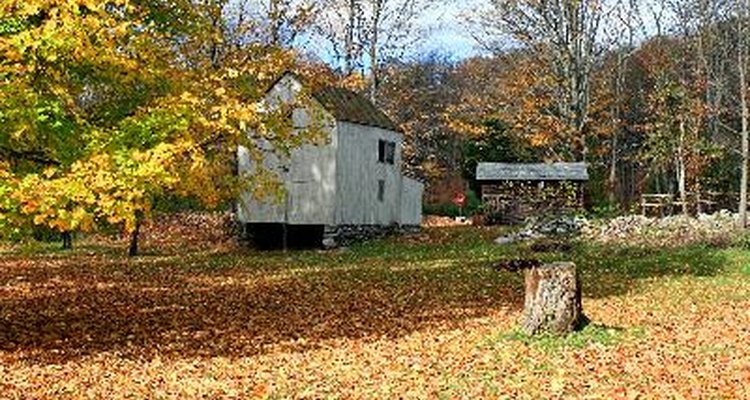
Life in Colonial New Jersey focused on the family, religion and the father's business or occupation. Unlike families in some of the other original 13 colonies who had to worry about hostile Indians, families in New Jersey maintained a peaceful coexistence with the local Lenni-Lenape. Some aspects of family life were influenced by the English law that ruled the colony. For example, although a mother was in charge of raising and caring for her child, the child's father was always considered his legal guardian.
Types
Family life in colonial New Jersey revolved around the family business. This business was usually farming. However, other industries also were operating at the time, including a fledgling attempt at whaling along the southern coast, mills, ironworks, lumber yards, and innkeeping. Boys helped in the fields or in the other businesses. Girls helped their mothers with the housework and garden. The females in colonial New Jersey grew the food, cooked all the meals and sewed all the clothes. Women didn't have to do it alone if finances allowed for servants.
Features
Holidays were celebrated much differently by families in colonial New Jersey than we currently celebrate them. For example, while Christmas today is an exuberant affair with gifts, family life in colonial New Jersey always marked the day quietly with religious observance. Families did not exchange gifts, but they did gather for a special dinner in the home with guests. Despite the low-key celebration, families in colonial New Jersey still had it better than families in Boston. The Puritans there banned Christmas for more than two decades.
History
The Dutch founded settlements in New Jersey in the early 1600s, and the English took control in 1664. The English named the colony for a place they left behind across the Atlantic Ocean, the Isle of Jersey. In 1687, New Jersey was split into East Jersey and West Jersey, and the two evolved quite differently. The former, settled by many stern Puritans, had at least a dozen laws on the books that called for punishment by death. The latter, under the rule of William Penn and the Quakers, was mild in comparison and did not inflict the death penalty for any crime. New Jersey became a state on Dec. 18, 1787.
Significance
The colony of New Jersey played a prominent role in the Revolutionary War. Federal legislation has declared significant revolutionary sites at the Crossroads of the American Revolution National Heritage Area. More than 500 sites, including family homesteads, played a major role in New Jersey's Revolutionary War experience. George Washington, who later became the new nation's first President, crossed the Delaware River from Pennsylvania to Trenton, New Jersey, with the Continental Army. He turned the tide of the war by defeating the Hessians. Some soldiers' wives went along as camp followers, but others remained home and took on all the work required to keep his occupation going.
Geography
New Jersey is bordered on the west by Pennsylvania. It's bordered on the north by New York. The Atlantic Ocean is on the east, and Delaware Bay borders the south. Because of its prime farmland and abundance, it was later dubbed the Garden State. This became its official nickname. Some sources credit Benjamin Franklin with the nickname, but others attribute it to Abraham Browning of Camden, New Jersey.
Related Articles

Haunted Places in Savannah, Georgia

The Essenes Diet

Traditional Roles of Men & Women in ...

Hispanic Clothing History
What Are the Family Ties for the Greek ...
What Type of Clothes Do Mexicans Wear?
History of African Peanut Soup

Free Things to Do in Fredericksburg, ...
About Kids in Colonial Times

Where Did the Beanie Hat Originate?
The History of Asian Food

School Uniforms in the 1940s
What Kind of Clothes Do They Wear in ...
Men's Roles in the 1800s

Fashion for Children in the 1960s

Irish Clothes of 1850

How to Prepare for Tet in a Vietnamese ...
Haunted Places in Savannah, Georgia
1950s Gangster Clothes
When Did Pierced Ears Originate?
Writer Bio
This article was written by the CareerTrend team, copy edited and fact checked through a multi-point auditing system, in efforts to ensure our readers only receive the best information. To submit your questions or ideas, or to simply learn more about CareerTrend, contact us [here](http://careertrend.com/about-us).
Photo Credits
Historic Millbrook Village image by Gary from Fotolia.com