
Acids and bases are compounds with one important thing in common: When you immerse them in solution, they release free ions. In an aqueous solution, which is the most common, the traditional way to differentiate them is that an acid releases positive hydrogen (H+) ions while a base releases negative hydroxide (OH-) ones. Chemists measure the strength of an acid or base by its pH, which is a term that refers to the "power of hydrogen." The midpoint of the pH scale is neutral. Compounds with a pH lower than the midpoint value are acidic while those with a higher value are basic or alkaline.
TL;DR (Too Long; Didn't Read)
Acids taste sour while bases taste bitter. An acid reacts with metals to produce bubbles of hydrogen gas while a base feels slimy to the touch. Acids turn blue litmus paper red while bases turn red litmus paper blue.
Evolving Definitions
The theory of an acidic or basic compound as being one that releases hydrogen or hydroxide ions respectively was introduced by the Swedish chemist Svante Arrhenius in 1884. The Arrhenius theory generally explains how acids and bases behave in solution and why they combine to form salts, but it doesn't explain why certain compounds that do not contain hydroxide ions, such as ammonia, can form bases in solution.
The Brønsted-Lowry theory, introduced in 1923 by chemists Johannes Nicolaus Brønsted and Thomas Martin Lowry, rectifies this by defining acids as proton donors and bases as proton acceptors. This is the definition chemists most often rely on when analyzing aqueous solutions.
A third theory, introduced by Berkeley chemist G.N. Lewis, also in 1923, regards acids as electron pair acceptors and bases as electron pair donors. The Lewis theory has the advantage of including compounds that do not contain hydrogen at all, so it lengthens the list of acid-base reactions.
The pH Scale
The pH scale refers to the concentration of hydrogen ions in a water-based solution. It's the negative logarithm of the hydrogen ion concentration: pH = -log [H+]. The scale runs from 0 to 14, and a value of 7 is neutral. As the concentration of hydrogen ions increases, pH gets smaller, so values between 0 and 7 indicate acids, while values from 7 to 14 are basic. Very high and very low values of pH indicate dangerously corrosive solutions.
The Taste of Acids and Bases
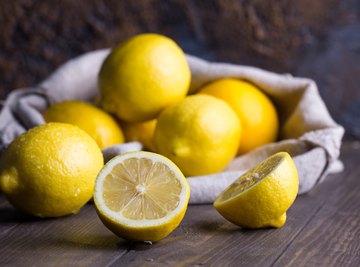
If you were to compare the taste of an acidic solution to a basic one – which is not advisable if the pH is very high or very low – you would find that an acidic solution tastes sour while a basic one tastes bitter. The sour taste in citrus fruits is due to the citric acid they contain, vinegar is sour because it contains acetic acid and sour milk is high in lactic acid. Alkalizing mineral water, on the other hand, has a mild but noticeably bitter taste.
Bases Feel Slimy, Acids Make Gas
When an alkaline solution such as ammonia and water combines with fatty acids, it makes soap. That's what happens on a small scale when you run a basic solution between your fingers. The solution feels slippery or slimy to the touch because the alkaline solution is combining with the fatty acids on your fingers.
An acidic solution doesn't feel slimy, but it will make bubbles if you immerse metal in it. The hydrogen ions react with the metal to produce hydrogen gas, which bubbles to the top of the solution and dissipates.
The Litmus Test
The ages-old test for acids and bases, litmus paper is filter paper that has been treated with dyes made from lichens. An acid turns blue litmus paper red, while a base turns red litmus paper blue. The litmus test works best if the pH is below 4.5 or above 8.3.
References
About the Author
Chris Deziel holds a Bachelor's degree in physics and a Master's degree in Humanities, He has taught science, math and English at the university level, both in his native Canada and in Japan. He began writing online in 2010, offering information in scientific, cultural and practical topics. His writing covers science, math and home improvement and design, as well as religion and the oriental healing arts.